

State-of-the-art race simulators have become an indispensable tool in modern motorsport offering drivers valuable insights into a circuit’s corners, straights and even its camber ahead of race weekends.
“We try to give the driver the feeling of the car — the steering and acceleration forces — as much as possible to get the right feedback and the right predictions for the track,” explains Gerhard Schagerl, AVL’s manager of race engineering.
“It’s not only the hardware, it’s the software, the graphics, the sound, the physics — all these highly developed (mathematical) models.
“This is not off-the-shelf technology,” adds Schagerl, who estimates the AVL simulator’s worth at €1 million ($1.1 million).
“You really need to develop this for every new racing class and for very specific customers. A lot of engineering goes into it.”
Bird highlights an important function of the simulator — in Formula E, the emphasis is not only on track learning but managing the car’s battery power during the course of an ePrix.
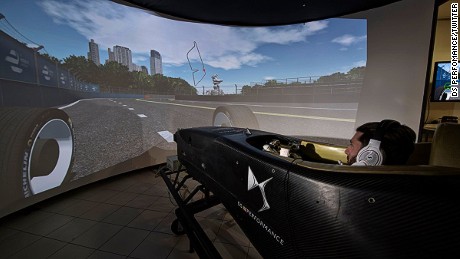
“In Formula E specifically, the battery, the electric motor and power electronics are modeled in a computer program to help drivers prepare for a race,” Schagerl explains.
For electric racers like Bird and Di Grassi the simulators are indispensable bits of kit, enabling them to push the limits safety before heading out onto the real track where there is little margin for error.
“I would say we can get almost 95% of the work done,” Di Grassi says. “It’s a very sophisticated video game which has a big influence on how we perform.
“On the sim, you normally over drive to find the limit because if you crash into the wall you can start again.
“On the circuit you under drive because if you crash your session is over.”






