

But when it comes to North Korea, he may be forced to operate within the narrow constraints of his predecessors.
President Obama famously decided that the best way of dealing with the autocracy was with a policy of “strategic patience.” In practice, this meant strengthening sanctions and waiting for North Korea to decide itself that halting its nuclear program would be prudent.
Trump’s Twitter activity, prior to his inauguration, suggested that he was in agreement with this line of thinking.
But while taking such steps would be vigorous and decisive, it could possibly lead to a wider war.
Seoul, the South Korean capital, is within striking range of North Korean artillery, and Kim Jong Un has not been shy about his readiness to lash out.
Such escalations might include the shelling of South Korean-held islands off of his coastline, the insertion of landmines into the Demilitarized Zone, attacks on the South Korean navy, or even commando attacks on the Blue House (the home of South Korea’s president) in Seoul.
This context is important to remember when trying to understand the limits facing Trump in constraining North Korea, a country that has managed to grab headlines recently with another missile launch.
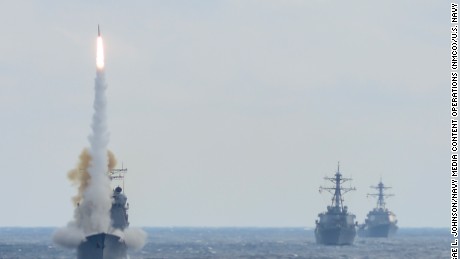
When he was in Seoul earlier this month, US Defense Secretary James Mattis sought to deter North Korea by threatening the country with “a response that will be effective and overwhelming” in the event of an attack on the US or its allies.
But this most recent North Korean test was neither nuclear nor an intercontinental ballistic missile capable of striking the United States.
This incremental advance in North Korea’s weapons program, therefore, wasn’t “the big one” in terms of steps the country could take to provoke the US.
Nor has the country resumed its nuclear tests since Trump arrived in office — having carried out four such tests during the Obama years, undeterred by UN resolutions forbidding such actions.
The Obama administration had pushed very hard for the inclusion of human rights and even International Criminal Court prosecution as a pressure point against North Korea, much to the anger of the regime.
North Korean state media is at present keeping its powder dry: it has not yet attacked Donald Trump by name or criticized him for anything.
Even Mattis’ visiting Seoul and the meetings between National Security Adviser Michael Flynn with his South Korean counterpart were not lambasted.
For all its reputation of being a crazed and irrational state, North Korea appears to be taking a rational approach to Trump and waiting to see what happens in Washington.
So could Trump, so keen on deal-making, use this small leverage to talk some sense into Kim Jong Un? Unlikely. If North Korean state media is to be believed, Kim’s subjects are hungering for a showdown with the US — and are fiercely proud of their emerging nuclear deterrent and missile capabilities.
It is doubtful that Trump will be able to change this. Short of sending Tillerson or traveling to North Korea himself, it seems unlikely that he will make a significant breakthrough.

The only realistic approach for the White House, it seems, would be to closely monitor the rhetorical chest-thumping — along with the huge military exercises on both sides of the DMZ — and hope that a small conflagration does not escalate into something more dire. In other words, with North Korea taking a seemingly more cautious approach with the new administration, “strategic patience” may bring Trump more success than it did Obama.






