

“You’re not looking for work, or to start a new life. You’re just saying, ‘I want to save myself,'” he says, remembering his desperation.
But instead Jone found himself trapped in limbo. He is one of hundreds of refugees whose requests for asylum have been rejected by Dutch authorities; unable to return home, they are also blocked from work or study.
“The biggest mistake I made in my life was to demand asylum in the Netherlands,” he says.
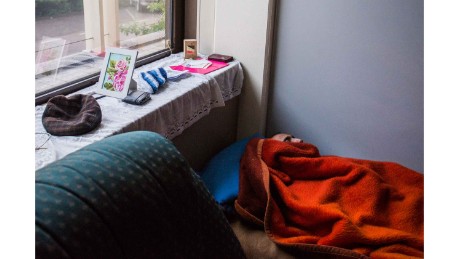
The group’s over 200 members come largely from war-torn African and Middle-Eastern countries, and are stuck in what human rights groups say is an “asylum gap,” legally barred from integrating into Dutch life via jobs or training courses.
“If you want to be active to fight for your rights, first you need shelter over your head,” says Jone. “When you have a place to sleep, you can relax and … it can help you think about what you want to do.”
Over the past four and half years the group has taken over approximately 30 empty buildings across the city for varying intervals, staying until they are evicted, and then moving on to the next site.

“I think it’s the most important problem that the Netherlands is facing,” says Klaas, who says the government is working with “the fiction” that asylum seekers can leave “even though they know that’s not true.”

A spokeswoman for the Netherlands’ Immigration and Naturalization Department, Yvonne Wiggers, told CNN that when an asylum seeker’s application is rejected “they go back home.”
Wiggers says cases are reviewed individually, but if the system determines that asylum is not an option, then “the conclusion is that they need to leave Holland and go back to their own country.”
For asylum seekers in WAH who have been rejected, she said the options are limited: “That’s not to say they don’t get any shelter, because of course there are citizens in Holland and churches and all kinds of people who help these people, but from a government side, they can’t claim shelter anymore.”
The decision about whether to provide shelter to asylum seekers whose claims have been rejected is largely up to local municipalities, and varies widely in practice.

Klaas describes the letter as “horrible,” adding “if you look at the rhetoric not only from [Rutte’s VVD party] but a lot of the political parties, they want to get these votes from Wilders, so they’re also shifting to the right.”

“When you come here they try to intimidate you,” says Eric Bimule. “You’re telling your story and they’re saying, ‘You’re lying, it’s not true.’ That’s hard. How can you tell me my story’s not true? It’s my story. I’ve lived this story.”
Bimule says he was flown out of the Democratic Republic of Congo aged 16 by his mother, a Dutch national, after the Congolese militia repeatedly tried to recruit him as a child soldier.
Eleven years on, he says he no longer believes in the asylum process.

Even for refugees whose applications are successful, there can be difficulties.
Somali refugee and WAH advocate Bushra Hussein’s asylum request was recently granted and she is now living in the Netherlands on a temporary residency permit, which allows her to study. She says she wanted to become a doctor, but the years spent waiting for asylum have limited her options. Instead, she’s studying to be a nurse.
But even while helping people, she says she’s subject to racism. During work experience at a nursing home, one elderly man told her she doesn’t belong in the country as a Muslim.

Despite this, Hussein still hopes to be able to integrate into life in the Netherlands.
“In the younger generation, most of them, they don’t care about religion,” she says. “I hope [they] can bring change to the country.”
Many WAH members who are still waiting for documents don’t share her optimism.
Tegisti Taklo fled Eritrea over fears of military conscription and religious persecution as a Christian. Having left her mother and young son behind, she says she has more problems as an undocumented refugee in the Netherlands than she did at home.

“Sometimes I say to myself, ‘Why did I leave?
“For six years I don’t study, I don’t take care of my son, I don’t help my mother, I don’t help myself even. I just feel like nothing.
“Sometimes I really wish I died in my country.”
What effect is Wednesday’s election likely to have on people like Hossein, Taklo and Jone?
“The best result we could have here is what we’re seeing in the US right now — a movement in the streets, in courts, campaigning, lobbying, people claiming their basic human rights again, and using solidarity,” says Dutch human rights lawyer Klass.

Jone too, believes ordinary citizens in the Netherlands have as much of a role to play as the politicians.
“Trump, Wilders, these people are not bad people, they are just misled,” he says.
“Everyone is responsible to try and engage in dialogue with them. That is the only way we will be able to live together in this world.”
All photographs by Sarah Tilotta.






