

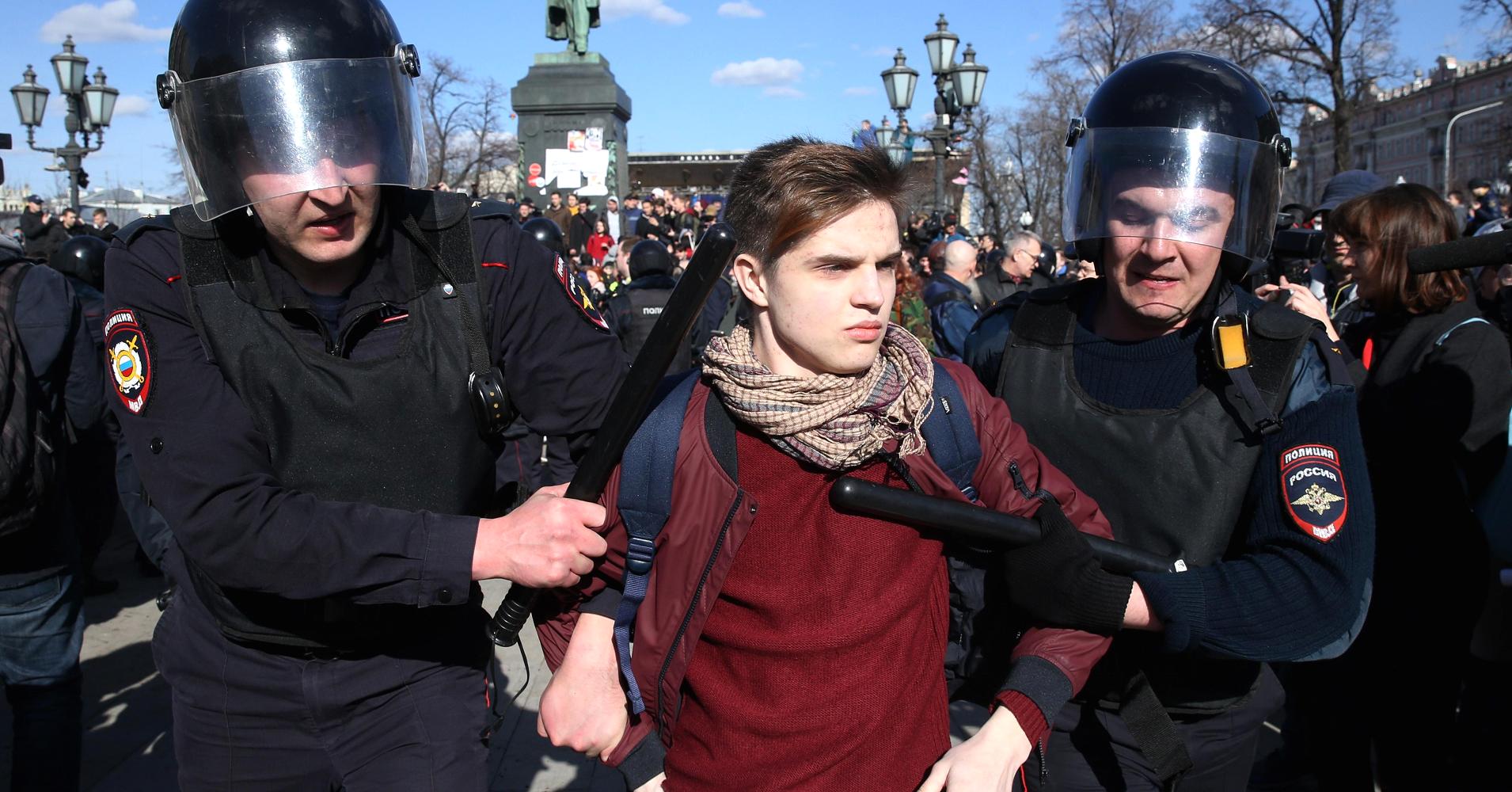
What happened at the protests?
Navalny’s anti-establishment calls prompted as many as 99 rallies across the country Sunday, however, all but 17 were declared illegal by authorities, resulting in hundreds of arrests.
Navalny was among those arrested and placed in a police truck as he walked with protestors near Moscow’s Pushkin Square. 17 of Navalny’s associates were also arrested in their office, according to the Associated Press.
Sunday’s arrests, which range in estimates from 500 to over 1,000 people, have been condemned by international authorities, including the EU and the U.S., who have called for the release of detainees.
“We call on the Russian authorities to abide fully by the international commitments it has made, including in the Council of Europe … To uphold these rights and to release without delay the peaceful demonstrators that have been detained,” the European Union said Monday.
However, Russia rejected these calls Monday, describing the demonstrations as illegal and accusing the organizers of paying teenagers to attend.
Kremlin spokesperson Dmitry Peskov called the protests a “provocation”, speaking to reporters via a conference call, and said authorities were concerned that opposition activities would try to encourage further illegal activity.
What’s next for Navalny as he faces trial?
Navalny appeared in court Monday where he faced charges of staging an unauthorized protest. If found guilty, he could face up to 15 days in jail.
Navalny is already serving a five-year suspended sentence, which could serve as a pretext for an automatic jail sentence and call into question his chances of running against Putin in next year’s election.
Navalny posted a selfie from the courtroom Monday Morning, saying: “There will come a time when we will judge them – and it will be fair.”
What does this mean for the Kremlin?
The outcome of Navalny’s trial is likely to give some indication of the Kremlin’s on-going stance towards this wave of discontent.
Putin’s government is sensitive to political demonstrations and corruption allegations and a series of recent corruption charges against Russian officials suggest that it is seeking to respond to popular criticism, suggests Tim Ash, emerging markets senior sovereign strategist at Bluebay Asset Management.
“It seems likely that we will see Medvedev shuffled out in the very near future – and likely well ahead of presidential elections due in March 2018,” predicts Ash.
“It will be interesting whether Putin goes for a reformer such as Kudrin, or perhaps Nabuillina, to inject some new momentum into the regime – perhaps also providing some outreach to Russia’s new found allies overseas, e.g. from within the (Donald) Trump White House.”
This could also lead to further economic concessions as the incumbent government tries to make up for the perceived misspending of public funds, notes Andrius Tursa, CEE adviser at Teneo Intelligence.
However, equally possible is a push to rebuild nationalist sentiment by embarking on “foreign adventures”, as was seen with the annexation of Crimea following the last wave of major protests, suggests Ash.
“Putin can go either way, or perhaps try both,” Ash said.






