
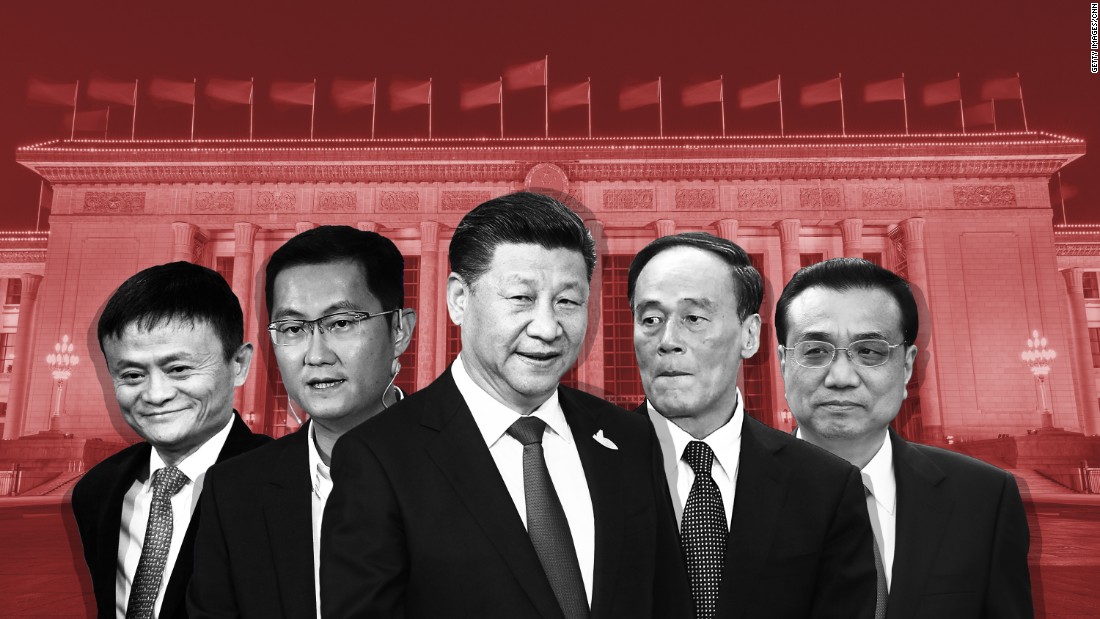
The country is ruled by the Chinese Communist Party, in a one-party system, making whoever occupies the highest positions in the party among the most powerful.
Power isn’t just held by the politicians either — influential businessmen and entrepreneurs, the pioneers of China’s economic rise, are also fighting for a seat at the table.
As Beijing gets ready for the biggest event in China’s political calendar, the 19th National Congress of the Communist Party on October 18, we polled 10 experts, asking them to pick who they thought were the top five most powerful people in China.
Their answers on who really pulls the strings were varied, and shed light on the upcoming Congress — akin to a closed-door election when China’s next generation leaders are expected to be unveiled.
Here’s who makes up the top five, according to the policy advisers, academics and journalists we spoke to.
5. Li Keqiang
In theory, Premier Li is number two in China’s power structure, but his influence is far from assured.
In 2012, he was appointed as the head of government in China, taking over as Premier and second only to Xi Jinping on the all-powerful Politburo Standing Committee.
“The general manager of the second largest economy in the world, he has dealt with the complex economic, social, and technological transformation of the largest country in the world,” China politics expert Zhiyue Bo told CNN, who placed Li third on his list.
So why is he so far down the overall list?
“He’s regarded as being a sort of low-profile, not particularly interlinked or interconnected premier. He’s got probably the worst job in China. The premier is always going to be taking the rap for stuff,” Kerry Brown, professor of Chinese politics at King’s College London, told CNN.
Brown added many of Li’s patronage networks, such as the Youth League faction, are believed to have lost their power under Xi Jinping, whose base is mostly made up of the children of former party leaders, or “princelings.”
“Of course he’s got the State Council (the country’s primary administrative authority and chaired by Li), of course he’s influential, he’s trying to get things done, but it’s not a sort of political power. It’s administrative power,” he said.
“Power is about initiating, setting frameworks, setting the agenda. Well you can see people doing that, but Li Keqiang is more of an administrator.”
4. Ma Huateng
Living in China, there’s only one app you must have on your phone — because every other person has it.
In a country without Facebook or Twitter, WeChat is a combination of both — and much more — and wildly popular.
“He wields massive influence because of the ubiquitous use of WeChat … Several powerful business leaders have had their wings clipped in recent years, but the technology sector has so far escaped relatively unscathed,” said Tom Rafferty, China regional manager for the Economist Intelligence Unit, who ranked Ma third on his list.
Ma, who is also known by his nickname “Pony,” founded Tencent, the company which owns WeChat, in 1998 with his university classmates. Two decades later, he is now the company’s chairman and its value has skyrocketed.
“(China’s internet kingpins) have been able to leverage the potential for China to internationalize its internet behemoths to make sure that it remains part of the global internet community — even with huge restrictions on that global status,” Rana Mitter, director of the University China Center at Oxford University, said, placing Ma second in his ranking.
“One challenge for tech titans like Ma in the coming years is whether they can keep on the good side of the authorities, as their wealth and influence continue to expand,” said Rafferty.
3. Wang Qishan
Shortly after taking power in 2012, President Xi boldly announced he was going to tackle China’s endemic corruption, warning both low and high-level officials, or “flies and tigers” in Chinese parlance, they would be in his sights.
For his tiger hunter, Xi chose former Beijing mayor and 2008 Olympics organizer Wang Qishan.
Since then, Wang has grown to be a powerful, feared figure among Chinese officials.
Rafferty said Wang is often described as the “second-most powerful” politician in China.
“He’s been an essential lieutenant for Xi … the president would be a weakened force without him at the top table,” he said, placing Wang second.
As a result of Xi and Wang’s crackdown, conspicuous spending and flaunting of wealth by officials has shrunk dramatically and as a result, Wang’s political capital has continued to rise.
But Wang’s rise could be complicated by his age. He’ll be 69 at the upcoming 19th Party Congress, meaning by custom he should retire.
Additionally, two analysts who didn’t rank Wang said his position had been weakened by unproven allegations from exiled businessman Guo Wengui, who has used social media to hurl accusations at China’s top leaders from the safety of the US.
Minglu Chen, senior lecturer at the University of Sydney, said while the substance of Guo’s claims may or may not be true, they came at a potentially damaging time for the vice-premier, potentially empowering his enemies in the lead up to the conference.
2. Jack Ma
But Jack Ma is without a doubt one of China’s most powerful people and possibly the country’s most public face internationally next to President Xi.
Ma, whose Chinese name is Ma Yun, is the executive chairman and founder of Alibaba, China’s powerhouse e-commerce site, as well as owning other massive online shopping platforms like Taobao.
His online platforms rake in hundreds of billions of dollars, making him the richest man in China as of September 2017.
Ma has met one-on-one with two US presidents, both Barack Obama and Donald Trump, and single-handedly created a national shopping holiday in China, “Single’s Day” on November 11.
“(Ma) has displayed vision and gusto in expanding his e-commerce empire,” Willy Lam, adjunct professor at Center for China Studies at Chinese University of Hong Kong, told CNN, who placed Ma third on his list.
“Even more striking is his determination to leverage Alibaba’s massive earnings to spearhead research in high-tech, particularly AI, cloud computing, “deep learning” and related know-how.”
“Political power trumps everything and anything in the party state,” Chen told CNN.
But Ma isn’t worried, if we put stock in one of his most famous quotes:
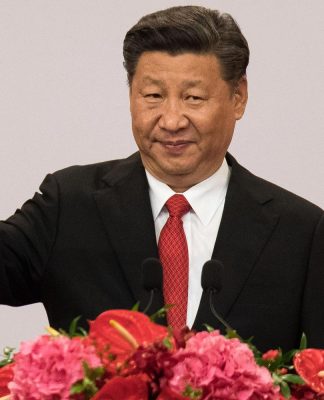
1. Xi Jinping
When contacted for our piece, Jeffrey Wasserstrom, professor of history at University of California, Irvine, said he wasn’t able to pick five different power players in China.
“The five most powerful people are the head of the party, the president, the commander in chief, the author of the book that gets the best display spots in the bookstores these days, and the guy the People’s Daily hails as China’s most astute commentator on globalization — in other words Xi, Xi, Xi, Xi, and Xi,” Wasserstrom told CNN.
Now with the upcoming Party Congress set to further cement his hold over the Communist Party, Xi’s power is only set to grow.
“The President and General Secretary has managed to concentrate more power and demote more rivals than any of his predecessors managed,” Mitter said, who along with each of the 10 analysts ranked Xi number one.
“That doesn’t mean all his opponents are gone,” Mitter said. “The next few years will show just how much he can make use of the power he has accumulated.”
A chess game
Perry Link, emeritus professor of East Asian studies at Princeton University, told CNN it was almost impossible to pick the top five most powerful people in China and projecting the mechanics of Western democracies onto China was misleading.
In total, our 10 experts gave us 24 different names who they considered China’s most powerful men and women.
Events of October’s party congress in Beijing could change everything — Wang Qishan could be forced to retire or Li Keqiang might even lose his number two position, the experts said.
But Link said it was impossible to know the thought processes and motivations of China’s most powerful men and women given the secretive nature of the Chinese system.
“What people really think is opaque beneath the chess game that they play, and the chess game itself goes on inside a highly impenetrable black box,” he said.
Graphics by CNN’s Max Pepper.