

The gathering in Hamburg will probably go down in history, not for nuts-and-bolts policy-making, but rather as a watershed moment when the world’s emerging and middle-weight powers took a decisive step out from the shadow of the United States and toward a globalized world order.
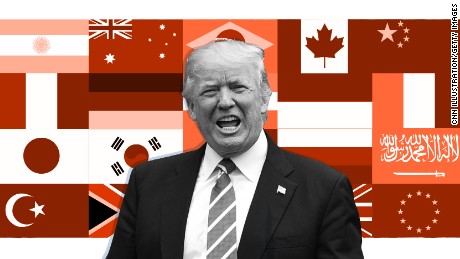
The G20 underscored more emphatically than ever before that there is no one leader of the free world anymore.
Of course, the United States hasn’t played the part of the world’s principal for some time now, at least since the wars in Iraq and Afghanistan in the early 2000s. Clout, economic as well as military, has since become more dispersed across the globe with centers of regional power in Europe, Asia and South America.
Even if there were an American president more internationally minded than Donald Trump, the world’s chief plights — terrorism, climate change, migration, nuclear proliferation — are all cross-border scourges that demand global responses with measures that apply locally.
Despite this, the Europeans — among others — still seem to defer to Washington on the tough issues, grumbling along the way but unwilling to break rank. Certainly, one reason for this is that they haven’t been able to replace the nuclear umbrella and US security guarantees with a fully fledged defense architecture of their own. NATO remains Europe’s security blanket, with the United States as the top gun and the Europeans as the ranch hands who sign up for foreign military interventions a la carte, the way sheriffs once rounded up cowboys.
But this Cold War-era state of affairs is ever less tenable or fitting, as comfortable as it once may have been.
Indeed, the Trump administration has thrown this status quo into disarray, for example by initially wavering — until his most recent trip to Poland — in the American commitment to coming to the aid of its fellow NATO members, should they require it.
Moreover, Trump’s isolationist leanings, his protectionist sympathies and, in general, the “America First” attitude has created a vacuum — one calling out for another figure to manage global trade, security, environment and other burning issues.
At the G20, Germany managed to hold together an extremely diverse group of countries, including the United States but also Russia and Turkey, whose authoritarian leaderships and me-first policies hardly pale compared to Washington’s. Russia’s Vladimir Putin and Turkey’s Recep Tayyip Erdogan were spoiling for fights with the European Union over human rights and other matters. And yet Germany’s Angela Merkel and others managed to get everyone on board, save for one issue.

Yet, the G19 — the 20 minus the Trump administration — went forward on climate and reconfirmed an international commitment to the Paris accord, which had begun to unravel since it was signed in late 2015. And, indeed, the Paris consensus could have disintegrated had other countries accepted an American compromise condoning coal and not mentioning the Paris accord, or had the assembly found no agreement at all, with half a dozen or more nations peeling off in opposition.
Washington’s intransigence could easily have served as cover for others unenthusiastic about climate policy, such as Turkey and Saudi Arabia, to bolt. But Merkel and her cohorts — other Europeans and Canada above all — rallied the stragglers in the final minutes.
Importantly, it wasn’t Merkel alone who pulled off the coup — and she won’t suddenly materialize as the new leader of the Western world, a role she neither wants nor could handle. (Merkel and France’s Emmanuel Macron would be extremely content with leading the EU out of its current deep crisis.) It must be kept in mind that Merkel has working beside her Germany’s Social Democrats, her left-wing partners in government and a diplomatic force in their own right, involved in all the negotiations.
Moreover, allies rallied to Germany’s side, including the United Kingdom and France, and together acted as a concerned, engaged collective that put the world first rather than their own nations — a laudable team effort that stands starkly counter to the selfish motives of the Trump administration and the disintegration that characterizes the EU at the moment.
Of course, there’s much more that the G19 could have done for climate — and in other areas, too. Unfortunately, there was no date set for shutting down that last coal-fired power plant. And there aren’t any details for Merkel’s new “partnership with Africa.”
But as vastly different as they are, the world’s nations beyond the United States have common interests and can work together. This is what the Hamburg summit confirmed — and is thus a reason to feel a little more optimistic about the state of the world. Next time, though, its leaders have to bring more vision and ambition to the table, whether the United States is playing ball or not.






