

The Trump administration warned Tuesday that U.S.-bound travellers from 10 airports in Turkey, the Middle East and North Africa will be banned from carrying certain electronic devices on board, owing to fears terrorists could conceal bombs in larger devices.
The restrictions will pertain to any electronics larger than a smartphone. Laptops, iPads, cameras, tablets, e-readers, portable DVD players and hand-held gaming consoles will no longer be permitted in the cabin and must instead be kept with checked luggage.
The exact wording from the Department of Homeland Security is that personal electronic devices “larger than a cellphone or smartphone be placed in checked baggage.” However, “approved medical devices” may be brought into the cabin after extra screening.
Here’s what else to know about the ban:
Who is covered?
Regardless of nationality, travellers flying on non-stop flights heading to the U.S. will be subject to the in-cabin restrictions on electronics. However, travellers whose flights originate from the U.S. will not be subject to similar rules when heading abroad.
In all, eight Muslim-majority countries will be affected.

electronics ban US (CBC)
Which airports and carriers are affected?
International flights from these 10 airports will be affected:
- Queen Alia International airport in Amman, Jordan.
- Cairo International airport in Egypt.
- Ataturk airport in Istanbul.
- King Abdulaziz International in Jeddah, Saudi Arabia.
- King Khalid International in Riyadh, Saudi Arabia.
- Kuwait International airport in Farwaniya, Kuwait.
- Mohammed V International in Casablanca, Morocco.
- Hamad International airport in Doha, Qatar.
- Dubai International Airport in Dubai, United Arab Emirates.
- Abu Dhabi International Airport in Abu Dhabi, United Arab Emirates.
Affected airlines include: Royal Jordanian Airlines, Egypt Air, Turkish Airlines, Saudi Arabian Airlines, Kuwait Airways, Royal Air Maroc, Qatar Airways, Emirates and Etihad Airways.
How long will this be in effect?
Airports will have 96 hours to comply with the security order, according to the Department of Homeland Security. Airlines were officially notified of the order at 8 a.m. ET on Tuesday, according to a Homeland Security fact sheet.
The Department of Homeland Security has said the restrictions will be imposed indefinitely.
However, an airline spokesperson with the UAE’s Emirates airline in Dubai said the directive would last until Oct. 14. CBC News has asked Homeland Security for clarity.
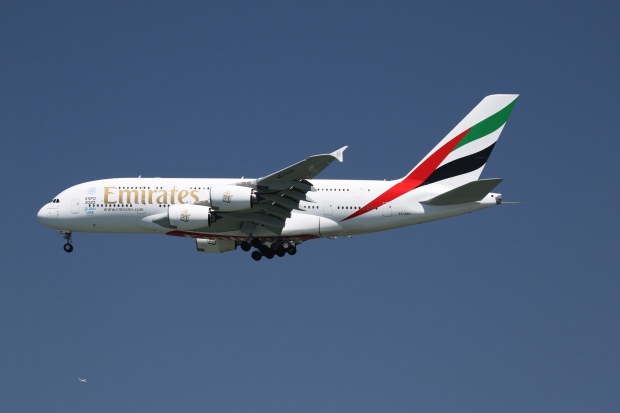
An Emirates Airlines Airbus A380-800 lands in San Francisco. Emirates is among the airlines whose passengers from certain airports could be affected by a new U.S. directive banning large electronics from nonstop flights from eight Muslim-majority countries. (Reuters)
How might Canada be affected?
The U.S. government specified that the rules would apply only in cases of direct U.S.-bound flights from the mostly Middle Eastern and North African countries. However, a statement from the Royal Jordanian airline stirred confusion about how some Canada-bound travellers might get caught up in the rules.
In a tweet that has since been deleted, Royal Jordanian wrote on Monday that Montreal would be included in the ban.
The wording of the Royal Jordanian advisory said, in part: “This announcement is effective starting with March 21, 2017, and the instructions will be applied on the New York, Chicago, Detroit and Montreal flights, the last two destinations served by a combined flight.”
CBC News has reached out to Royal Jordanian Airlines, Transport Canada and the Department of Homeland Security for clarification. (Homeland Security and Transport Canada both deferred to each other.)
“Please understand that is not a question that I am able to answer. I cannot speak for the Canadian government,” a Homeland Security Public Affairs spokesperson wrote in an email to CBC News.
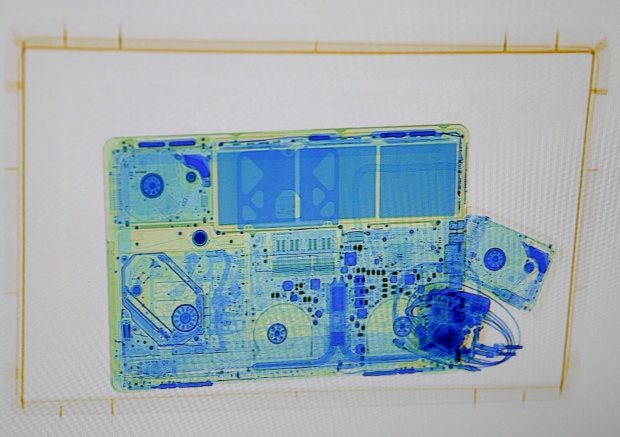
A laptop is seen on the screen of an X-ray security scanner. U.S. authorities have issued a directive restricting the use of electronics in the cabin for passengers flying direct to the U.S. from 10 airports in several Muslim-majority countries. (Dado Ruvic/Reuters)
What about passengers with connecting flights?
As with passengers flying direct from any of the affected airports to the U.S., travellers transferring through any of the 10 affected airports are being advised by the Transportation Security Administration to pack their large personal devices in checked baggage at their originating airport.
Is this a response to specific intelligence?
Homeland Security referred to historical interest from terrorists in targeting commercial aviation. In a release, the department says “evaluated intelligence” suggests terrorist groups intending to target commercial flights could look to “smuggling explosive devices in various consumer items.”
Are any other countries following the U.S.?
The U.K. announced its own electronics restrictions for inbound flights on Tuesday, though the restrictions differ from the U.S. order with regard to laptops and tablets. The U.K. ban targets six Middle Eastern countries: Egypt, Tunisia, Jordan, Lebanon, Saudi Arabia and Turkey.
The U.K. is focusing on devices “larger than a normal sized mobile or smart phone,” according to a spokesperson for Prime Minister Theresa May. That’s understood to be devices larger than 16 cm long, 9.3 cm wide and with a depth of 1.5 cm.
At a press scrum on Tuesday, Minister of Transport Marc Garneau told reporters he had spoken with U.S. Secretary of Homeland Security John Kelly about the U.S. directive. Garneau said he will examine information that has been presented to him before making a decision about whether Canada might follow suit with a similar order regarding electronics on flights.
How widespread will this impact be?
Homeland Security played down the scope of the enhanced security measures, saying in a release that “a small percentage” of U.S.-bound flights would be affected. The department noted that just 10 out of more than 250 airports that serve as last points of departure to the U.S. would be involved.
Some of the carriers named in the directive and operating out of the busiest hubs service direct flights to the U.S. about 50 times a day.






