

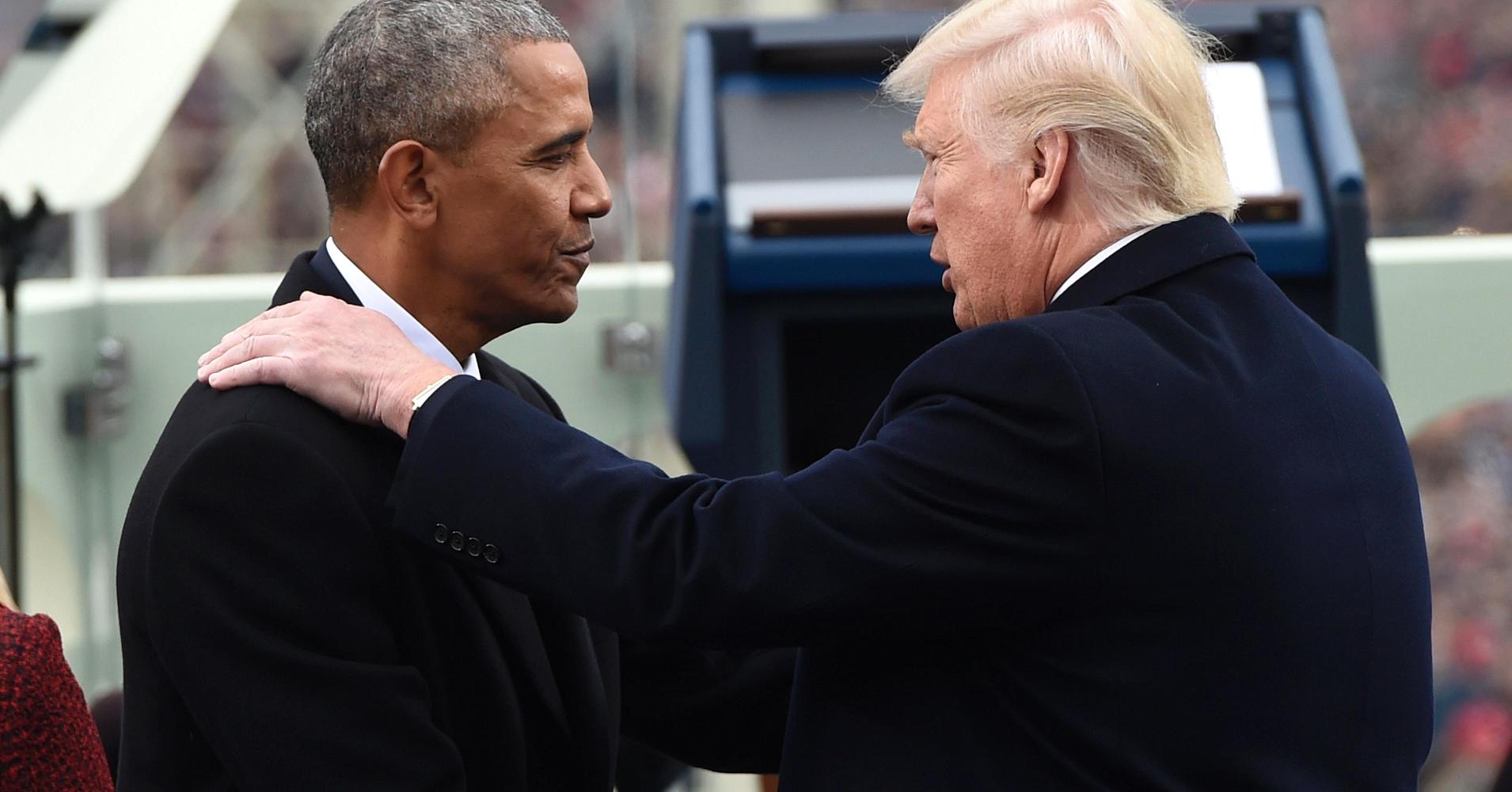
A few days after Trump’s inauguration, about 15 Obama aides began moving their supplies into a one-floor office less than 2 miles from the White House.
The Obamas themselves first visited the space in the first week of February. One staffer keeps a sketch of the White House South Lawn near his desk, next to a football adorned with the presidential seal. The former president’s personal office is located right down the hall from the first lady’s. Visitors are greeted with a sign painted in black lettering, “Welcome to the Office of President Obama,” ringed with handprints in green, red, and blue. The kitchen is stocked with Girl Scout cookies.
“It feels a bit like campaign office meets startup,” one staffer says.
The analogy speaks to the uncertainty about what exactly Obama’s team has been assembled to do.
The Obama office is stocked with key Democratic talent, such as Cody Keenan, the president’s speechwriter; Anita Decker Breckenridge, his former deputy chief of staff; and Caroline Adler Morales, the first lady’s communications director.
His team has been in talks with the offices of House Minority Leader Nancy Pelosi and Senate Minority Leader Chuck Schumer about once a week, one source said. They are also “in regular touch” with officials at the DNC, the Center for American Progress, the Democratic Governors Association, and several other progressive groups.
When Trump announced a new regulatory freeze on January 29, for instance, Obama aides provided congressional Democrats with information about a similar order he had issued in 2009. They monitor, and sometimes challenge, Trump’s accusations in the news.
On Tuesday night, the Huffington Post reported about this crew of Obama aides assembled in DC’s West End, with a headline declaring that Obama has a “bite your tongue policy on Trump.” A few hours later, a different headline based on the same reporting materialized on Breitbart, this time laden with ominous undertones: “Obama deploying dozen-strong team to ‘keep tabs’ on Trump administration.”
Just a couple of days earlier, Obama aides were stressing to me that the exact same office the Huffington Post and Breitbart were arguing over would itself be searching for ways to solve the partisan media echo chamber that so worries the president.
“Getting back to people talking to each other even if they fundamentally disagree is something he’s very interested in, particularly in this on-demand media environment where people gravitate toward their corners,” one aide said. “He’s very curious: How do we change that?”
Added another, when discussing their goals for the Obama Foundation: “You’ll find spaces where independents and Republicans can engage on this issue.”
It’s the essential question for Obama. Should the president worry about appearing too partisan to his opponents? Or is it more important for him to be forthcoming to his supporters about what he believes?
Ben Wikler, head of MoveOn.org, says Obama’s current approach is smart: Try to allow new voices to come to the fore, while subtly trying to look for ways to fuel the forces of the opposition.
“The real action now — the most powerful force in politics today — is the millions of people marching and demonstrating and demanding the protection of their health care,” Wikler says. “Recognizing that power comes from below — as opposed to oracular pronouncements from former officials — is a shrewd recognition. One reason Obamacare has become so popular is that it’s being seen as ‘care’ rather than ‘Obama.’ But that requires him getting out of the picture.”
But to others, Obama’s approach merely underscores the core failing not just of his post-presidency but of his entire political career.
“We got into the weakest position in decades through Obama’s attempt to live in a post-partisan world that doesn’t exist,” says Chamberlain, of DFA.
Even some neutral observers think this may be the wrong moment for Obama’s diligent avoidance of the partisan fray. “We can’t get to the point where we have these bipartisan or transpartisan discussions until Democrats win some elections — because nothing else is going to stop this juggernaut on the right,” says Theda Skocpol, a Harvard political scientist.
Democrats will get their first chance to cut into the Republican congressional majority next month, when a special election is held in Georgia’s Sixth Congressional District, to replace current Health and Human Services Secretary Tom Price.
The leading Democratic candidate is Jon Ossoff, a former congressional aide. His campaign has not yet heard from Obama.






