

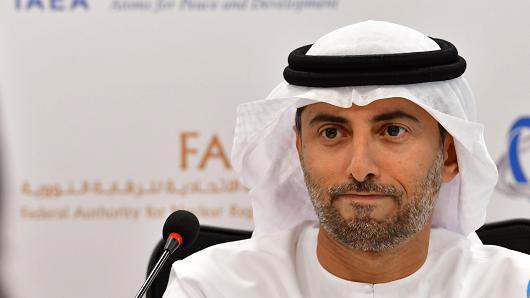
GIUSEPPE CACACE | AFP | Getty Images
UAE Minister of Energy Suhail Mohamed Faraj al-Mazroui attends a press conference on September 25, 2017 in Abu Dhabi, United Arab Emirates
Oil markets still have not completely balanced supply against demand just yet, United Arab Emirates’ (UAE) energy and industry minister said Thursday.
Speaking to CNBC at the 9th Gulf Intelligence UAE Energy Forum in Abu Dhabi, Suhail al-Mazroui said progress was being made, but there’s more than must be done.
“The market fundamentals in 2017 have been good but we’re looking forward to seeing another year this year,” he said.
“The concern is to achieve that balance between supply and demand, and we’re not there yet.”
Last November, OPEC and 10 non-OPEC producers led by Russia agreed to extend cuts to their oil output in an attempt to push prices higher. Starting in mid-2014, a slide in global demand combined with a boom in U.S. shale production to severely undercut prices.
The deal is due to run out in December 2018, although the producers will review the agreement at the next OPEC meeting in June to assess how it is impacting oil prices and global crude stockpiles.
Oil prices are hovering near three-year highs on Thursday, supported by a surprise drop in U.S. production as well as lower crude inventories. U.S. West Texas Intermediate crude futures were at $63.51 at 0530 London time while benchmark Brent crude futures were trading at $69.11 a barrel.
Al-Mazroui said the rise in oil prices showed market sentiment was good, but the correction in the market was a work in progress.
“There is of course a positive market sentiment that we’re seeing today … The market is balancing and this is what we’re saying, the issue is the timing and how long it will take,” he said.
However, al-Mazroui cautioned that data showing that demand was robust reflected the cyclical nature of oil demand.
“We need to take into consideration that we’re in the winter, and typically in the winter the demand is higher. In the second quarter you could see some softening, some refineries go to maintenance. You see demand changes during the year, so the cyclic event of supply and demand is something we see every year,” he said.
Mazroui’s comments are his first since the UAE assumed the presidency of OPEC, the major 14-member oil producing group, in 2018.





