

Feb. 10 (UPI) — President Donald Trump on Friday found no relief on the East Coast, either — a day after three California appellate judges backed a court order blocking the American leader’s move to deny U.S. entry to thousands of refugees and immigrants.
After hearing arguments in another lawsuit against Trump’s disputed order, U.S. District Judge Leonie Brinkema seriously questioned the administration’s reasoning for the executive action.
In addressing the civil case, Aziz v. Trump, Brinkema refuted Justice Department claims that Trump’s ban on immigrant travel is a security measure based on threats of terrorism.
The state of Virginia alleges in the case that the order is a “monumental abuse of executive power” intended to make good on Trump’s campaign pledge to bar all Muslims from entering the United States.
“There is strong evidence from the national security community that this order does not do what it purports to do,” Brinkema said. “There is strong, colorful evidence for the motives of this order.”
Several former top security officials, both Republican and Democrat, have said there is a total lack of evidence to suggest a real threat exists among immigrants from Iran, Iraq, Sudan, Somalia, Libya, Syria and Yemen — the seven majority Muslim nations identified in Trump’s visa ban. Some have even said the order, in fact, actually could undermine U.S. national security.
“I don’t have a scintilla of evidence that counters this argument,” Brinkema said, calling the executive action “broad and imprecise.”
“The courts have been begging you to provide some evidence and none has been forthcoming,” she said, claiming the order has “all types of deficiencies.”
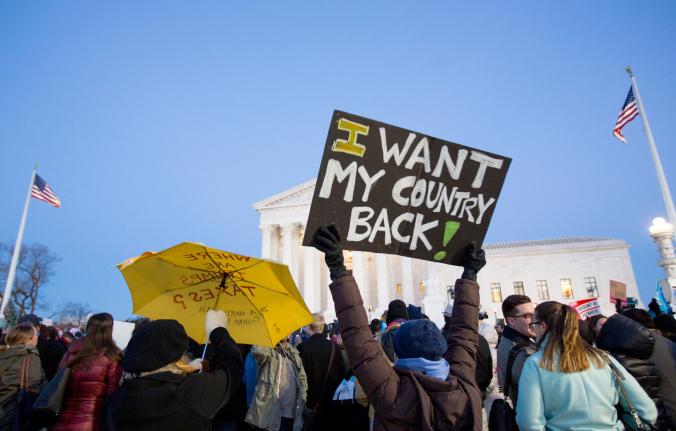
A protester holds a sign in front of the U.S. Supreme Court on January 30 to oppose President Donald Trump’s controversial order to ban U.S. entry for refugees and certain immigrants. Federal appellate courts have ruled that the government has not yet proven that allowing migrants into the United States would pose a risk of domestic terrorism. Photo by Erin Schaff/UPI
The Virginia case involves the detention of Yemeni brothers Tareq and Ammar Aqel Mohammed Aziz, lawful permanent residents, at Washington, D.C.’s Dulles International Airport on Jan. 28. Though they were deemed as admissible by the government, they were not allowed to leave the airport due to Trump’s order, which was signed the day before.
The suit claims 60 other foreign nationals, identified as “John Does” in court documents, were treated similarly. The case is one of several Trump’s order is now facing.
Thursday evening, a federal appeals court in San Francisco ruled against the order and said a temporary restraining order blocking the ban can continue while the case is fully evaluated by lower courts. The decision was a major setback for Trump’s administration.
The president reacted to Thursday’s decision sternly, calling it a “disgraceful decision” and pledged to “see you in court!”
Brinkema did not issue a ruling Friday but pledged one as soon as possible. If she rules for the state, it would strengthen the injunction already in place. If she favors the government, it would break ranks with Thursday’s ruling and perhaps hasten a showdown in the U.S. Supreme Court, where the issue is almost universally expected to end up.
During a news conference with Japanese Prime Minister Shinzo Abe on Friday, Trump again denounced the ruling and said he is confident his order will ultimately be upheld.
The president has said the order is entirely intended as a temporary security measure, and is not a blanket ban against Muslims.
“We will not allow people into our country who are looking to do harm to our people,” Trump said. “We will allow lots of people into our country that will love our people and do good for our country.”
The president added Friday that additional security measures are coming next week.






