
Hundreds of regime supporters gathered in plazas in parts of the city before marching toward the palace late Friday morning in celebration of the new body, some carrying Venezuelan flags and other banners.
One supporter, former Vice President Elias Jaua, evoked national hero Simon Bolivar and former President Hugo Chavez as he kicked off the march. Maduro is the handpicked successor of the leftist Chavez, who died in 2013.
“Let us go with God, with Bolivar, with our commander Hugo Chavez,” Jaua said. “Chavez lives! Chavez lives!”
Opponents of Maduro’s regime, on the other hand, were expected to gather at various points in Caracas around midday, intending to march toward the palace.
Sunday’s election was boycotted by opposition members, who say Maduro orchestrated the new body to get around the existing National Assembly, which the opposition has controlled since 2015.
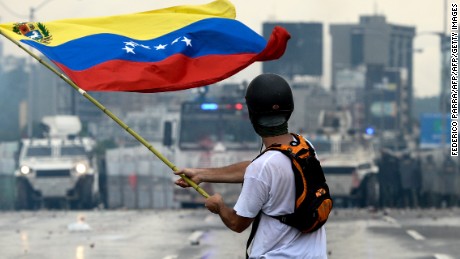
Virtually all of the Constituent Assembly members are supporters of the leftist leader, and the new assembly could abolish the old one as well as other state institutions. Critics say the moves would erase any last traces of democracy in the South American country.
Opposition leader returns to house arrest
An imprisoned political opponent of Maduro’s was released to house arrest hours before the assembly’s inauguration.
The whereabouts of the other political figure, Leopoldo Lopez, weren’t immediately known.
“Antonio said he comes back with concern that Leopoldo and more than 600 political prisoners continue behind bars,” Capriles tweeted on her husband’s account Friday.
Ledezma, a former Caracas mayor, and Lopez, a former mayor of the Caracas district of Chacao, had been under house arrest for separate allegations. Ledezma was arrested in 2015 on suspicion of being involved in a plot to overthrow the government, and Lopez was convicted that year of being behind a deadly anti-regime protest.
The two were taken to jail Tuesday after both publicly opposed Sunday’s election in videos posted to social media.
Venezuela’s Supreme Court said the men were taken because intelligence officials claimed they were planning to flee.
Voter fraud allegations
The National Electoral Council announced that more than 8 million people — about 41.53% of registered voters — went to the polls Sunday, but allegations of voter fraud quickly emerged.

Smartmatic CEO Antonio Mugica said his company stood by all previous results but this time, it noticed a discrepancy of at least 1 million votes between the officially declared tally and what the firm recorded.
A full audit would be needed to confirm the exact numbers, he said.
Maduro disputed the allegations and blasted Mugica; however, Venezuela’s attorney general launched an investigation into potential voter fraud within hours.
Attorney General Luisa Ortega Diaz told CNN en Español that two prosecutors are investigating four of five directors of the National Electoral Council “for this very scandalous act that could generate more violence in the country than what we have already experienced.”

A fifth director, Luis E. Rondón, had previously said there were fewer audits than customarily required during the vote and no use of indelible ink to prevent multiple votes. Rondón is the sole director of the electoral council who isn’t a supporter of Maduro’s.
On Thursday, US State Department spokeswoman Heather Nauert said the United States won’t recognize Venezuela’s National Constituent Assembly because “the process was rigged from the start” and “the election lacked credible international observation.”
Months of strife
Maduro is aligned with the political movement of Chavez, Venezuela’s President from 1999 until his death in 2013.
Chavez trumpeted a brand of socialism — dubbed Chavismo — in which he increased subsidies to the poor and fixed prices for goods but alienated Venezuela from foreign investors who were spooked by his anti-American rhetoric. Chavez chose Maduro to succeed him as interim President, and he narrowly won election in December 2013.
Venezuela became dependent on selling its oil abroad, and income suffered when the price of oil per barrel dropped from $100 in 2014 to $26 in 2016. Inflation has soared, and unemployment could reach 25% this year, according to the International Monetary Fund.
For months, Venezuela has struggled with the collapsing economy and a standoff between Maduro and the opposition. His opponents wanted to impeach him after they won a National Assembly majority in 2015, but he stacked the Supreme Court with his supporters, blocking any impeachment attempts.
The Supreme Court briefly attempted to dissolve the National Assembly in March, sparking a wave of nearly daily protests. More than 120 people have been killed in the ongoing unrest.
CNN’s Flora Charner, Khushbu Shah, Natalie Gallón, Julia Jones, Mariano Castillo and CNNMoney’s Patrick Gillespie contributed to this report.