
The United Nations children’s agency has issued a statement of protest against the reported killing of dozens of people, including several children, in the Syrian government’s bombardment of rebel-held suburbs of Damascus.
UNICEF’s one-page statement, released Tuesday by its regional director for the Middle East and North Africa, carries the headline: “Do those inflicting the suffering still have words to justify their barbaric acts?”
The headline is followed by blank space underneath. UNICEF said it issued this blank statement because “we no longer have the words to describe children’s suffering and our outrage.”
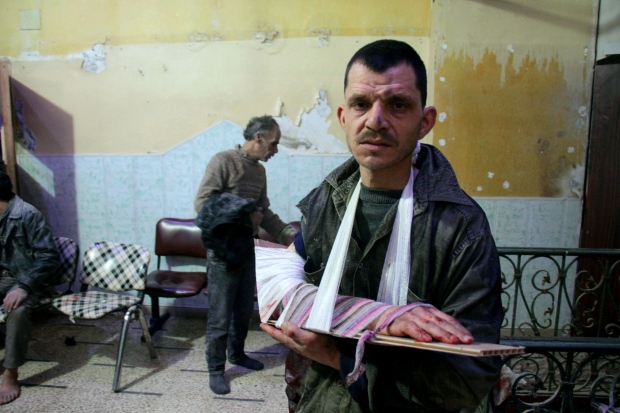
This man was wounded during airstrikes on the Syrian village of Mesraba in the besieged eastern Ghouta region on the outskirts of Damascus on Monday. (Hamza al-Ajweh/AFP/Getty Images)
Syrian opposition activists and paramedics said airstrikes and shelling on Monday killed 127 people, including at least 20 children, in the rebel-held eastern Ghouta suburbs of the capital of Damascus.
The Britain-based Syrian Observatory for Human Rights said the daily death toll was the highest in the area since 2015.
The group said about 190 people have died since the bombing intensified late Sunday and 850 have been injured.
The violence in eastern Ghouta is part of a wider escalation in fighting on several fronts in Syria as President Bashar al-Assad pushes to end the seven-year rebellion against him.
Mortars fired by rebels in eastern Ghouta landed in Damascus on Tuesday, causing two deaths and several injuries, Syrian state media reported. At least one person died from rebel mortar fire in the capital on Monday.
Lebanon’s al-Manar television, which is aligned with Assad’s ally Hezbollah, reported on Monday that the Syrian army was sending reinforcements toward eastern Ghouta after rebel assaults.
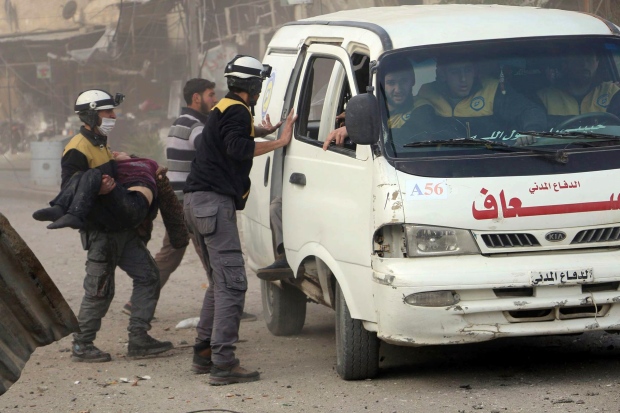
This photo provided by the Syrian Civil Defence White Helmets has been authenticated based on its contents and other AP reporting. It shows a civil defence worker carrying a victim after airstrikes hit a rebel-held suburb near Damascus on Feb. 8. (Syrian Civil Defence White Helmets/Associated Press)
Assad’s most powerful supporter, Russia, has been following a diplomatic track at the same time as the increase in fighting, resulting in the establishment of several “de-escalation zones.”
Eastern Ghouta is in one of these areas, where violence is meant to be contained, but the de-escalation agreement does not include a former al-Qaeda affiliate that has a small presence there.
Other insurgent groups in eastern Ghouta, including Islamist factions, say the Syrian government and Russia are using the jihadist presence as a pretext to continue their bombardment.
Neither the Syrian military nor Russia commented on the renewed bombardment in the region, but they have often said they do not target civilians.
The observatory said the intensified bombing was in preparation for a pro-government ground offensive against the enclave and that a rebel group there had foiled an attempt by Syria’s army to advance overnight.
France said on Tuesday that the bombing of eastern Ghouta by pro-government forces amounted to a serious violation of international humanitarian law and called for a humanitarian truce.
The attacks “deliberately target inhabited areas and civilian infrastructure, including medical ones. They constitute a grave violation of international humanitarian law,” the foreign ministry said in a statement.