
The U.S. Senate is headed for a tense showdown this week over President Donald Trump’s first Supreme Court nominee that could have far-reaching consequences for Congress, the high court and the nation.
Senate Judiciary Committee Chairman Chuck Grassley says the Senate is aiming to confirm Judge Neil Gorsuch before a two-week break that starts April 10. Gorsuch wrapped up three days of testimony on his nomination before the Senate Judiciary Committee last week.
Majority Leader Mitch McConnell and his Republicans are determined to confirm Gorsuch. But to do so, they will likely have to override Democratic objections and a threatened filibuster, and unilaterally change Senate rules so that he can be confirmed with a simple majority in the 100-seat chamber, instead of the 60-vote threshold.
Though it may seem arcane, the approach is known on Capitol Hill as the “nuclear option,” because it strikes at the heart of the Senate’s traditions of bipartisanship and collegiality.
It would allow all future Supreme Court nominees to be confirmed without regard to the objections of the minority party. And senators of both parties say that proceeding with the rules change could ultimately lead to complete elimination of the minority party’s ability to block legislation via filibuster, one of the few remaining mechanisms that force bipartisan co-operation in Congress.
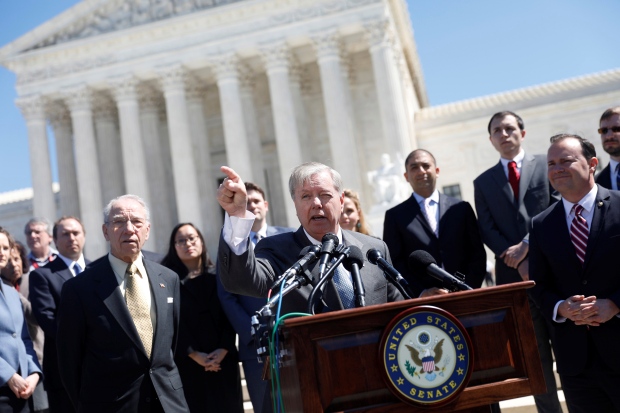
Republican Senator Lindsey Graham speaks at a rally for nominee Neil Gorsuch outside the U.S. Supreme Court in Washington, D.C. on March 29. (Aaron P. Bernstein/Reuters )
“Once you go down this path, it’s awful easy just to keep going, and that is not a good thing,” said senior Republican Senator Pat Roberts, of Kansas.
Nevertheless, Republican senators are fully prepared to take the step, blaming Democrats for forcing them into it by preparing to filibuster a well-qualified nominee.
And Democrats are just as ready to push the Republicans to pull the trigger, even as they argue that McConnell and the rest of the party will have only themselves to blame.
“[McConnell] can prove that he cares about the Senate by not changing the rules,” Minority Leader Chuck Schumer, of New York, told The Associated Press.
Deal ‘virtually impossible’
Schumer told the Washington Post last week that “it’s virtually impossible” that both parties can come to “any kind of agreement” on the confirmation.
As of now, Gorsuch claims support from 54 senators — the 52 Republicans, along with two moderate Democrats who are up for re-election in states Trump won: Joe Manchin of West Virginia and Heidi Heitkamp of North Dakota.
One by one, most of the other Democrats have lined up against Gorsuch, citing his rulings in favour of corporations or his vague answers during his confirmation hearings. Though Democrats remain a handful shy of the 41 votes that would be required to mount a filibuster and trigger a rules change, it is the widely expected outcome.
No Democrat has yet pledged to support the judge, but Joe Manchin said last Wednesday he is open to voting for him. McConnell could also change Senate rules to confirm Gorsuch with a simple majority, and appears prepared to take that step.
“I remain very worried about our polarized politics and what the future will bring, since I’m certain we will have a Senate rule change that will usher in more extreme judges in the future,” Democratic Senator Claire McCaskill, of Missouri, said Friday as she became the latest Democrat to announce plans to join the filibuster against Gorsuch.
Gorsuch, 49, has served more than a decade as a federal appeals court judge based in Denver. He is mild-mannered but deeply conservative, in the mould of the justice he would replace, Antonin Scalia, who died in February 2016.
McCaskill and other Democrats have pointed out that while Gorsuch’s confirmation won’t change the ideological balance of a court that will be likely to split 5-4 on important cases, that could be what happens next as liberal justices age along with Justice Anthony Kennedy, 80, who often acts as a swing vote.
Republicans argue that the filibuster has almost never been used against a Supreme Court nominee and they are right; even Clarence Thomas got onto the court without a filibuster, despite highly contentious confirmation hearings over sexual harassment claims from Anita Hill.
The only Supreme Court nominee to have been blocked by a filibuster was Abe Fortas, President Lyndon Johnson’s nominee for chief justice in 1968. After a procedural vote failed, Johnson withdrew Fortas’ nomination. Fortas was already a sitting justice on the court.
60-vote threshold for Supreme Court picks
But the Supreme Court blowup has been a long time coming — and both parties share the blame.
Republicans were prepared to invoke the “nuclear option” on lower court nominees in 2005, but a bipartisan group of 14 senators made a deal that stopped it. Then Democrats took the step in 2013 when they grew frustrated over lower court nominees getting blocked, but left the Supreme Court subject to a 60-vote threshold.
Now, with Trump in the White House and politics ever more polarized, there appears to be no room for compromise.
Democrats are still fuming over the treatment of former president Barack Obama’s Supreme Court nominee, Merrick Garland, who never even got a hearing from Republicans last year after Scalia died.
And for Republicans, Gorsuch’s nomination is the one positive note so far in the trouble-plagued Trump administration, and they are determined to get a win.
Though some Republican senators have privately counselled caution, McConnell has no plans to wait and has declared definitively that Gorsuch will be confirmed on Friday. If Gorsuch joins the court shortly thereafter, he would be in time to hear the last set of cases in the court’s current term, including one about church-state separation.
The stage will be set for the next Supreme Court nominee to be confirmed with a simple majority, potentially tilting the court ideologically for decades to come. And an uncertain future will await the filibuster itself, and the Senate as a deliberative, bipartisan institution.
“It just continues on a downward spiral; it’s us that’s to blame, it’s the base, it’s responding to the base on each side,” said Republican Senator Bob Corker, of Tennessee. “It’s both sides that have taken us to this place.”