
U.S. President Donald Trump will deliver a broad and harsh critique of Iran in a speech Friday declaring that the landmark Iran nuclear deal is not in America’s national security interests, according to U.S. officials and outside advisers to the administration.
Trump’s speech from the White House, scheduled for about 12:45 p.m. ET, will outline specific faults he finds in the 2015 accord,, but will also focus on an array of Iran’s troubling non-nuclear activities, four officials and advisers said.
Those include Tehran’s ballistic missile program, support for Syrian President Bashar al-Assad, Lebanon’s Hezbollah movement and other groups that destabilize the region, including in Yemen.
Under U.S. law, Trump faces a Sunday deadline to notify Congress whether Iran is complying with the accord that was painstakingly negotiated over 18 months by the Obama administration and determine if it remains a national security priority.
Although Trump will allow that Iran is living up to the letter of the agreement, he will make the case that the deal is fatally flawed and that its non-nuclear behavior violates the spirit of the regional stability it was intended to encourage, the officials and advisers said.
The officials and advisers, who insisted on anonymity because they were not authorized to publicly preview the speech, said Trump will not call for a re-imposition of nuclear sanctions on Tehran.
He will instead urge lawmakers to codify tough new requirements for Tehran to continue to benefit from the sanctions relief that it won in exchange for curbing its atomic program. And he’ll announce his long-anticipated intent to impose sanctions on portions of Iran’s Revolutionary Guard Corps by designating them terrorist organization under an existing executive order, according to the officials and advisers.
In addition, Trump will ask Congress to amend or replace outright the legislation that currently requires him to certify Iranian compliance every 90 days. Officials have said that Trump hates the requirement more than the nuclear deal itself because it forces him to take a position every three months on what he has denounced as the worst deal in American history.
That frequency has also irritated aides who have complained that they are spending inordinate amounts of time on certification at the expense of other issues.

Iranian Revolutionary Guards march in 2008. The group controls large swaths of Iran’s economy. (Vahid Salemi/Associated Press)
“The reckless behaviour of the Iranian regime, and the IRGC in particular, poses one of the most dangerous threats to the interests of the United States and to regional stability,” the White House said in a statement released ahead of the speech.
The statement, which didn’t reveal Trump’s decision, denounced the Obama administration for its “myopic focus on Iran’s nuclear program to the exclusion of the regime’s many other malign activities” and said the same “mistakes” would not be repeated.
“The Trump administration’s Iran policy will address the totality of these threats from and malign activities by the Government of Iran and will seek to bring about a change in the Iranian’s regime’s behaviour,” it said.
Ali Larijani, Iran’s parliament speaker, said Friday that any U.S. move against a nuclear deal with Iran would be an “insult” to the United Nations, because the UN had given the deal its blessing.
He added that any revision of the deal would allow Iran to take its own actions, and warned that the U.S. move could destabilize the international situation.
“We will continue to adhere to our obligations … for as long as other parties observe the agreement,” he said on a visit to Russia.
‘Despotic theocracy’
At the White House, Trump’s chief of staff, John Kelly, confirmed the president would announce the results of his Iran policy review on Friday but declined to offer any detail. Secretary of State Rex Tillerson was calling foreign minister colleagues from the other parties to the deal to brief them on what to expect, the State Department said.
But in a preview of Trump’s announcement, CIA Director Mike Pompeo blasted Iran during a speech at the University of Texas, calling Iran’s Ministry of Intelligence and Revolutionary Guard “cudgels of a despotic theocracy.”
The IRGC, which is responsible for external operations, is expanding its power across the Middle East, Pompeo said. “Unlike ISIS and its mirage of a caliphate, Iran is now a powerful nation-state that remains the world’s largest state sponsor of terror.”
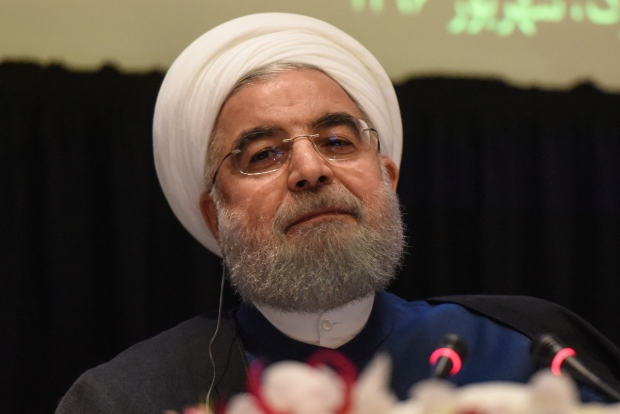
Iran’s President Hassan Rouhani delivers remarks at a news conference during the United Nations General Assembly in New York City in September. The threat of new action from Washington has prompted a public display of unity from the rival factions among Iran’s rulers. (Stephanie Keith/Reuters)
Unresolved issues
American allies, who have pressed the White House to remain in the nuclear accord, will be closely watching the president’s address. Trump wants to impress on the European parties to the accord — Germany, France and Britain — the importance of fixing what he sees as flaws in the nuclear accord and addressing malign behavior not covered in the agreement.
The Europeans, along with the other parties, Iran, Russia and China, have ruled out reopening the deal. But some, notably France, have signaled a willingness to tackle unresolved issues in supplementary negotiations. Among those issues are the expiration of several restrictions on advanced nuclear activity under so-called “sunset clauses” that will allow Iran to begin ramping up its enrichment capabilities after 10 years, the end of an arms embargo and the eventual easing of demands for a halt to its missile program.
In the speech, Trump hopes to “recruit” the Europeans into joining his broad strategy, particularly by punishing the Revolutionary Guard, which he and his national security team believe is fomenting instability, violence and extremism throughout the Middle East and beyond, according to one official.
In anticipation of Trump’s announcements, Republican legislators have drawn up a new version of the law replacing the current 90-day timetable with “semi-annual” certifications, according to drafts seen by the Associated Press this week.