
U.S. President Donald Trump is preparing to give a keynote speech to the leaders of more than 40 Muslim-majority countries on the second of a two-day visit to Saudi Arabia.
He is expected to use the address at the Arab Islamic American Summit in Riyadh to call for a unified approach in confronting the threat of religious extremism.
Trump has been holding individual meetings with Gulf Arab leaders from Bahrain, Egypt and Qatar and will participate in a roundtable of the Gulf Cooperation Council.
White House adviser Dina Powell has told reporters that a memorandum of understanding signed by the U.S. and GCC nations represents the “farthest reaching commitment” to not finance terrorist organizations.
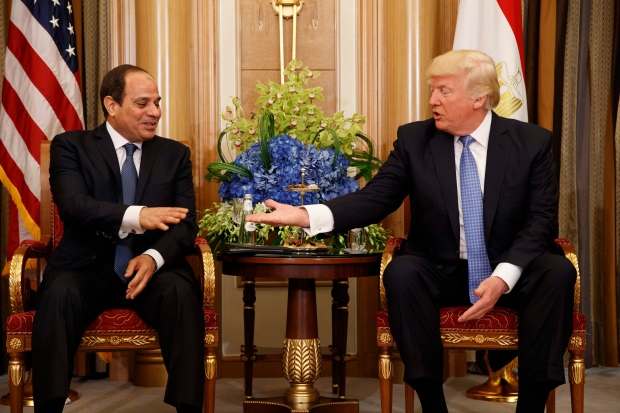
Another meeting took place with Egyptian President Abdel Fattah al-Sisi. (Evan Vucci/Associated Press)
She said it includes a pledge to prosecute the financing of terrorism, including individuals.
Whether Trump will use his signature campaign phrase “radical Islamic terrorism” in his speech to describe the threat is unclear.
His speech was still being worked on late on Saturday and some advisers were cautioning him against using the term.
Trump’s Riyadh visit kicks off his first presidential trip abroad, with Saudi Arabia the first stop on an eight-day journey through the Middle East and Europe.
The U.S. president says he will hold a news conference in about two weeks to discuss how well the fight against ISIS is going.
Meanwhile, a senior Israeli cabinet minister has voiced concern about the U.S.’s $110 billion arms deal with Saudi Arabia, announced Saturday.
Yuval Steinitz, a confidant of Prime Minister Benjamin Netanyahu, said Israeli officials will have to “hear the explanations” of the deal when Trump arrives in Israel on Monday.
Steinitz said it is crucial that Israel maintain its military edge over its Arab neighbours, despite warming ties with Sunni Arab countries like Saudi Arabia.
Steinitz says, “This is not a country that we have diplomatic relations with” and that it “is still a hostile country and nobody knows what the future holds.”
Steinitz says the deal is “definitely something that should trouble us.”