
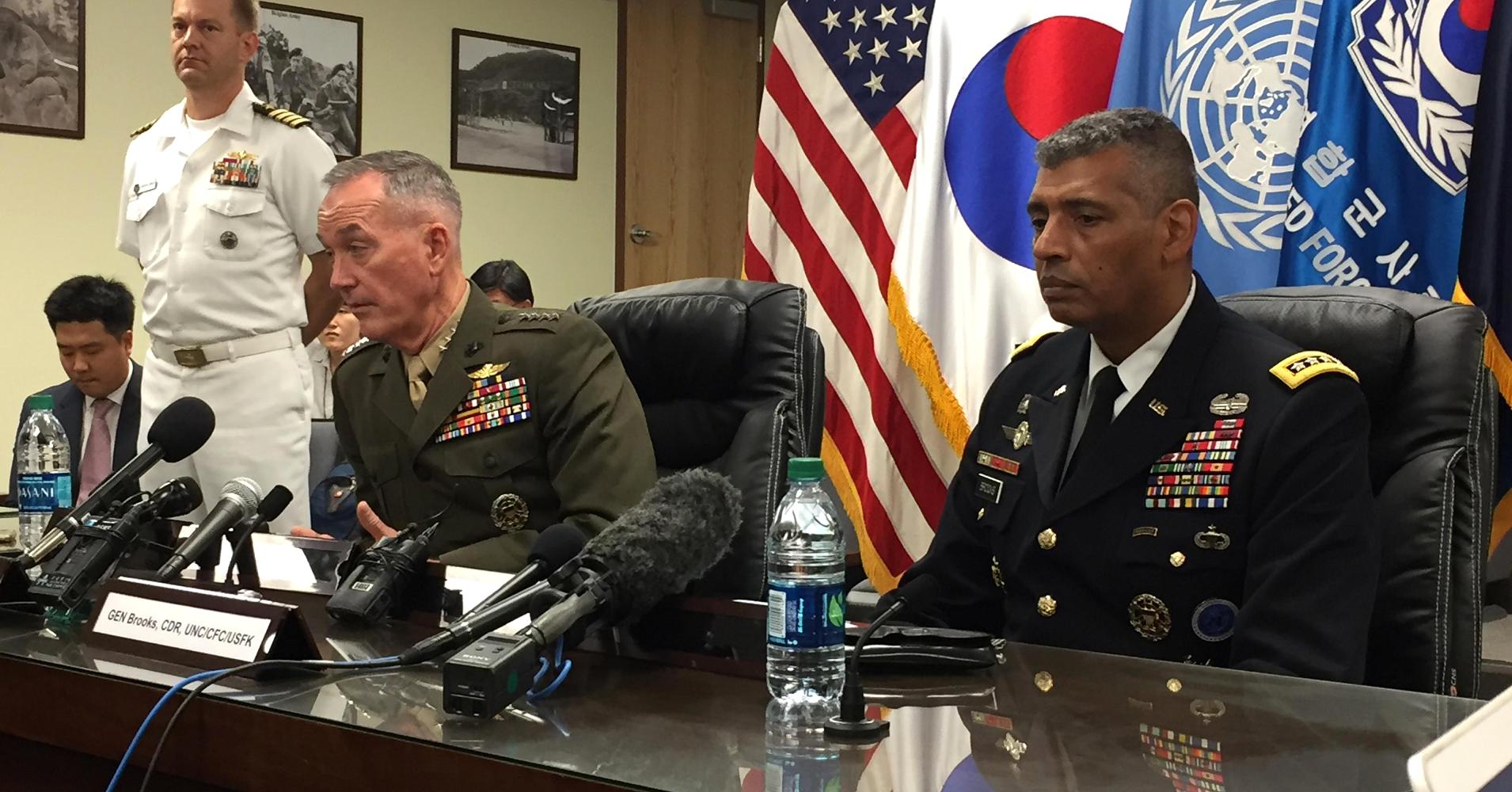
The nation’s top military officer vowed Monday during a Seoul visit that the U.S.-South Korean alliance is ready to defend against the threat from North Korea.
Marine Corps Gen. Joseph Dunford, the chairman of the Joint Chiefs of Staff, and Army Gen. Vincent Brooks, the alliance commander in Korea, made the comments to reporters after meeting in Seoul with South Korean President Moon Jae-in and top South Korean military officials.
“The message today was the ironclad commitment to the alliance,” Dunford told reporters.
Dunford added, “What I would like to see is Kim Jong Un to commit to ceasing the development of nuclear weapons and ceasing the testing of ballistic missiles.”
The visit comes on the heels of nuclear-armed North Korea’s warning last Wednesday that it is “carefully examining” a plan to test-fire a missile into the waters off the U.S. Pacific territory of Guam with missiles. The dynastic regime led by the 33-year-old Kim also detailed how the missile would travel over Japan.
“We listen very carefully to Kim Jong Un’s rhetoric and we can’t afford to be complacent,” said Dunford. “We have to take it seriously in regards to our defensive measures, and with regard to the development of military options in the event we are called upon to do that.”
The North Korean threat followed President Donald Trump’s warning last Tuesday that the hermit regime faces “fire and fury” if it makes more threats against the U.S. The president followed it up Thursday with a comment that maybe his earlier warning to the North wasn’t tough enough.
Guam is home to more than 6,000 U.S. troops, and there are about 28,500 American service members stationed in South Korea and about 50,000 U.S. forces in Japan.
At the same time, the alliance commander Brooks said “[Troops from both South Korea and the U.S.] tell me that they want to be ready. They want to make sure they can do all they can to be prepared. They want to know if they have reason to be concerned, and in the meantime we tell them to continue their mission, and they do it very, very well every single day.”
Brooks also confirmed the Ulchi-Freedom Guardian joint military exercises will go forward as planned next week. The joint U.S.-South Korean annual military exercises usually last about two weeks.
Some suggest the joint military drills could risk inflaming tensions as Pyongyang has viewed them as a provocation. However, Brooks said despite condemnation from the North there were compelling reasons to go forward with the annual joint military exercises.
“We have to have a credible deterrent,” the Army general said. “This is why we have military capability that undergirds our diplomatic activities. These threats are serious to us, and thus we have to be prepared.”
The war game exercises last year involved about 25,000 U.S. service members on the Korean peninsula and about 50,000 South Korean troops, as well as a contingent of soldiers from several other U.S. allies.
As for Guam, Dunford was asked what would happen if North Korea were to follow through with its threat to launch missiles against the U.S. territory.
“What we would do in the event of an attack on Guam — or missiles being launched toward Guam — is a decision that will… be made by the president of the United States and he will make that in the context of our alliance,” responded Dunford.
Added Dunford, “Our job — General Books and I — is to make sure our leadership has options available to them to properly respond.”
Even so, the nation’s highest ranking military officer said he held out hope there might be a change in the tone from Pyongyang. “We are seeking peaceful resolution to the crisis right now,” the general said.
Last month, North Korea test-fired its second intercontinental ballistic missile, with some Western experts estimating the July 28 launch of the Hwasong-14 long-range missile revealed that the ICBM could reach half, if not most, of the continental U.S.
Also, the Washington Post was the first to report last week North Korea was able to produce a miniaturized nuclear warhead that can fit inside its missiles and said the Kim regime may have “up to 60 nuclear weapons” in its arsenal, citing a Defense Intelligence Agency assessment.
After his meetings in South Korea, Dunford then traveled to China for his first visit there as chairman of the Joint Chiefs of Staff.
In a statement Monday, Dunford said his primarily objective for the Chinese trip is to “continue to develop our military-to-military relationships, to mitigate the risk of miscalculation in the region and to have cooperation where those opportunities exist.”
Dunford’s office also quoted U.S. defense officials as saying the Chinese visit “is in support of Secretary of State Rex Tillerson’s diplomatic and economic campaign to deter North Korea.” They added, “Success in that campaign would be a North American commitment to denuclearization and a halt of missile tests.”
Dunford also is scheduled on the trip to stop in Japan for discussions with top government and military officials.
Earlier this month, the 15-member United Nations Security Council passed stricter economic sanctions against North Korea, which could cut the regime’s export revenues by a third.
China and Russia were among the Security Council’s members voting for the new North Korean sanctions. Reuters reported Monday that China’s Commerce Ministry had issued the banning order for the sanctions.
Still, China state media on Monday reiterated Beijing’s strong opposition to the THAAD missile shield in South Korea. China contends the system’s powerful radar gives the U.S. and South Korea capability not only to spot missiles fired from the North but to potentially look deep into China to monitor military activities.
“THAAD deployment will not help to ease the ROK’s security concerns, and will do even less to resolve the nuclear issue on the Korean Peninsula,” the state-run Xinhua news agency quoted a Chinese Foreign Ministry as telling reporters Monday. ROK, or Republic of Korea, is the formal name of South Korea.