
Andrew Harrer | Bloomberg | Getty Images
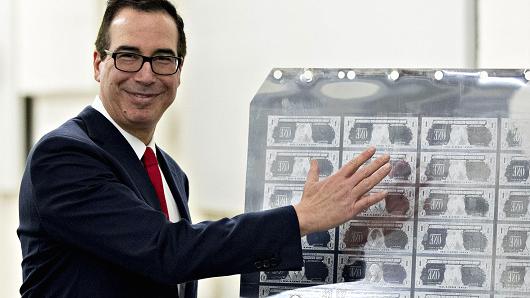
Steven Mnuchin, U.S. Treasury secretary, gestures while standing next to a printing plate for $1 dollar notes bearing Mnuchin’s name at the U.S. Bureau of Engraving and Printing in Washington, D.C., U.S., on Wednesday, Nov. 15, 2017.
The political calculations appear fairly straightforward. Democrats, who opposed tax reform with near unanimity, are expected to point to the government’s surging borrowing, hammering away at that theme until the November midterm elections. Critics of President Donald Trump‘s economic policy will also point to the irony of his remarks as a candidate, when he suggested the government could inflate away its debt simply by printing money.
Conventional economic wisdom suggests that in the long term, Uncle Sam’s burgeoning debt load will put upward pressure on interest rates and hammer the dollar (which has also taken a beating, in spite of soaring yields that theoretically should help bolster its appeal).
While printing money to erase debt seems like an easy solution, most economists warn it would put the world’s largest economy on a fast track to hyperinflation and a devalued currency (think Zimbabwe and Venezuela).
A force multiplier behind Treasury borrowing is the cost of doing so is already at historically low levels — thanks to the Fed’s ultra-loose, crisis-era monetary policy. In fact, the Mercatus Center at George Mason University points out that interest rates have been on the decline for more than three decades, and borrowing costs for new debt issues are at least 5 times lower than 10 to 20 years ago.
“Such dramatic declines in borrowing costs put the Treasury in the driver’s seat when it came to funding deficits,” noted William Beach, Mercatus’ vice president for policy research, in a recent essay, noting that the average interest rate on public debt was less than 2.5 percent.
“Although the overriding consideration of the Treasury during the recession and recovery was simply funding the trillions in new debt, the low and declining average and marginal costs of doing so no doubt encouraged borrowing,” Beach added.
As for the U.S. and its relentless borrowing needs, the stakes are high. Analysts point out that U.S. debt is on the rise at a time when the economy’s trajectory is on pointing up. For Trump, soaring interest rates and greater government borrowing may conspire to undermine his lofty economic goals—especially his 3 percent growth target.
Indeed, last month the International Monetary Fund warned about the scenario currently unfolding in global markets.
The fund said that the near-term outlook was constructive, but said tightening financial conditions around the world “would have implications for global asset prices and capital flows, leaving economies with high gross debt refinancing needs and unhedged dollar liabilities particularly exposed to financial distress.”