

House Republicans unveiled their tax reform bill Thursday – leaving in place current 401(k) retirement plans and eliminating some state deductions.
President Trump praised the plan but said “there is much work left to do.”
Here’s a look at what the legislation tackles.
401(k) plans
Despite weeks of arguing among lawmakers, the bill didn’t change the 401(k) retirement plans. Republicans had considered slashing pretax donation limits from $18,000 to as low as $2,400 for some Americans.
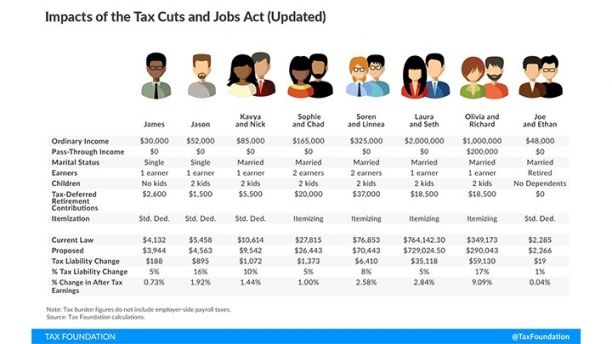
How the proposed tax plan would affect different Americans and their families.
(Tax Foundation)
State and local deductions
After the tax reform framework was revealed last month, some lawmakers grumbled about a provision that would eliminate state and local tax deductions – meaning taxpayers in high-taxed states would lose a write-off. This impacted mostly blue states, such as California and New York.
The latest bill ditches a full repeal of the deductions, called SALT, and instead leaves in place state and local property tax deductions up to $10,000. However, other deductions – such as income and sales tax – would be eliminated.
WHO ARE THE WINNERS AND LOSERS OF TRUMP’S TAX REFORM PLAN?
“I view the elimination of the deduction as a geographic redistribution of wealth, picking winners and losers,” said Rep. Lee Zeldin, R-N.Y., who also said he doesn’t support the current bill.
Corporate taxes
The corporate tax rate would be lowered to 20 percent from 35 percent. It’s unclear if this reduction would be immediate or gradually implemented.
Mortgage deduction
The plan would drastically reduce the cap on the popular deduction to interest on mortgages to $500,000 for newly purchased homes from the current cap at $1 million.
Child tax credit
The child tax credit is raised to $1,600 from $1,000. The $4,050 per child exemption is also eliminated.
Sen. Marco Rubio, R-Fla., said in a tweet that the House tax plan was “only [the] starting point.” He said the $600 child tax credit was not enough to help working families.
High-income households
The legislation eliminates the Alternative Minimum Tax, a supplemental tax meant to offset benefits a person with a high income could receive.
The bill also phases out the so-called estate tax – sometimes referred to as a “death tax” by opponents. The federal estate tax generally affects wealthier Americans because it is only levied on a portion of an estate value transferred after death that exceeds a certain exemption level, according to the Center on Budget and Policy Priorities.
Tax filing
The legislation aims to simplify how Americans file their taxes. The filing system would be able to be completed on a postcard with just 15 lines for most Americans.
The plan also shrinks the number of tax brackets from seven to three or four, with respective tax rates of 12 percent, 25 percent, 35 percent and a category still to be determined.
GOP TAX BILL: NO CHANGES TO 401(K), DOUBLES DEDUCTIONS FOR MIDDLE CLASS, LIMITS STATE AND LOCAL TAX
“This is the beginning of the end of this horrible tax code in America,” Rep. Kevin Brady, R-Texas, told Fox News.
The plan sets a 25 percent tax rate starting at $90,000 for married couples, with a 35 percent rate beginning to bite at $260,000 — which means many upper-income families whose top rate is 33 percent would face higher taxes. Individuals making $500,000 and couples earning $1 million would face the current Clinton-era top rate of 39.6 percent.
The non-partisan Tax Foundation has reviewed the proposal to determine how the new rates and deductions could affect single and multiple-income earning households. “Our results indicate a reduction in tax liability for every scenario we modeled, with some of the largest cuts accruing to moderate-income families with children and fixed-income retirees,” the group said in its review.
Fox News’ Chad Pergram and Barnini Chakraborty contributed to this report. The Associated Press also contributed to this report.






