

Authorities in Spain and France are pressing ahead with their search for the supposed ringleader of an Islamic extremist cell that carried out vehicle attacks in Barcelona and the seaside resort of Cambrils, as the investigation focused on links among the Moroccan members and the house where they plotted the carnage.
Catalan police said the manhunt was centred on Younes Abouyaaquoub, a 22-year-old Moroccan suspected of driving the van that plowed into a promenade packed with pedestrians in Barcelona on Thursday, killing 13 and injuring 120.
Even with Abouyaaquoub still at large, Spanish Interior Minister Juan Ignacio Zoido declared that the terrorist cell responsible for the carnage had been effectively “broken” after five members were killed by police in a shootout, four were in custody, and as many as two were killed in an explosion earlier in the week.
He said there was no new imminent threat of attack.
Early Saturday, police searched two buses in northwest Catalonia. Nothing was found in the searches in Girona and Garrigas, police tweeted.

Muslim residents of Barcelona hold messages reading ‘I am a Muslim Catalan, i am not a terrorist. Islam is peace’ and ‘We are also afraid’ as they demonstrate on Las Ramblas boulevard in Barcelona on Saturday. (Lluis Gene/AFP/Getty Images)
Across the Pyrenees, French police carried out extra border checks on people coming from Spain — a routine beefing-up of patrols any time a neighbouring country flags a potential risk, a French security official said, speaking on condition of anonymity. No arrests were made.
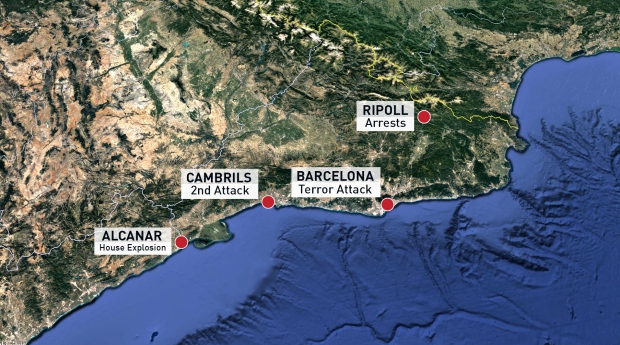
Police also announced a series of controlled explosions Saturday in the town of Alcanar, south of Barcelona, where the attacks were planned in a rental house destroyed Wednesday by an apparently accidental blast. Authorities had initially written off the incident as a household gas accident, but took another look on Friday and returned on Saturday.
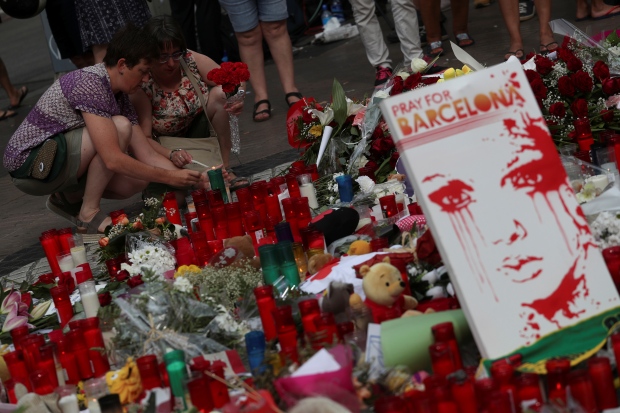
Two women light a candle Saturday at an impromptu memorial where a van crashed into pedestrians at Las Ramblas in central Barcelona. (Sergio Perez/Reuters)
Police believe the Wednesday night blast prevented a far deadlier attack using explosives, forcing the extremists to use more “rudimentary” vehicles instead.
Initially, only one person was believed killed in the blast. But police said tests were underway to determine if human remains found at the house on Friday were from a second victim.
The Islamic State in Iraq and Syria (ISIS) initially claimed responsibility for the Barcelona attack, which took place on the city’s famed Las Ramblas. In a new statement Saturday, it also claimed the attack a few hours later in Cambrils, in which five extremists mowed down people along the boardwalk in the seaside resort.
Fake explosives belts on Cambrils attackers
One woman died and five others were injured in Cambrils before police shot and killed all five attackers. They were armed with an axe, knives and fake explosives belts. The ISIS statement provided no information beyond what had been previously reported.
Authorities said the two attacks were related and the work of a large terrorist cell that had been plotting for a long time from the house in Alcanar, 200 kilometres down the coast from Barcelona.
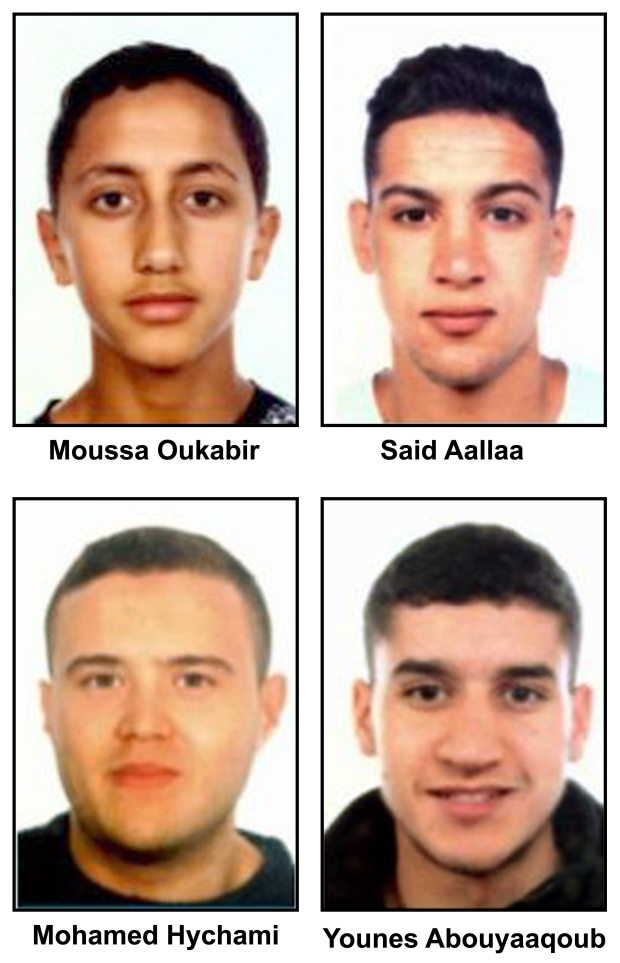
Police identified four Moroccan men they say were involved in the attacks. Three seen in this photo were gunned down by officers in Cambrils, while the search continues for Younes Abouyaaqoub. (Spanish Police/EPA)
The name of the lone suspect at large, Abouyaaquoub, figures on a police list of four main suspects sought in the attacks. All the suspects on the list hail from Ripoll, a quiet, upscale town of 10,000 about 100 kilometres north of Barcelona.
On Friday, police searched the apartment of Ripoll’s imam, neighbours said.
Suspect list also distributed in France
The suspect list was issued throughout Spain and into France, according to a Spanish official and a French police official, who spoke on condition of anonymity.
The French official said Spain had flagged a rented Kangoo utility vehicle that was believed to have been rented in Spain by a suspect in Thursday’s attacks that might have crossed the border.
Also named on the list is 17-year-old Moussa Oukabir, whose brother, Driss, reported his documents stolen to police in Ripoll. Ripoll’s mayor confirmed the documents were found in one of the vehicles used in the attacks.
The brothers were born and raised in Ripoll, where the family’s first-floor apartment was searched Friday. No one was home.
4 in custody, including 3 Moroccans
Neighbours said they were shocked by the news of Moussa Oukabir’s alleged involvement. One teenager, who identified himself only by his first name, Pau, said they played together when they were younger and he was “a good boy.”
In addition to the five people killed in Cambrils, police said they arrested two people Friday, after the two arrests a day earlier. In custody are three Moroccans and one Spaniard, none with terrorism-related records.
“We are not talking about a group of one or two people, but rather a numerous group,” regional Interior Ministry chief Joaquim Forn told Onda Cero radio.
The sheer size of the cell recalled the November 2015 attacks in Paris, in which trained ISIS attackers struck the national stadium, a concert hall, and bars and restaurants nearly simultaneously. Since then, the extremist group has steadily lost ground in its self-declared caliphate in Iraq and Syria, most recently with its defeat in Mosul.
“This shows there is no correlation between what is happening over there with Daesh and the operational capacity of the group,” said Jean-Charles Brisard, a French security analyst, using another name for the group.
Spanish authorities had not yet drawn any direct links between ISIS extremists and the suspects in the Spanish attacks, but the possibility that members of the Spanish group could still be at large was chilling. Those who have survived prior attacks nearly always ended their lives with new bloodshed and a hail of police bullets.
“There is the danger they will not let themselves get caught and will do something dramatic,” said Alain Chouet, a former French intelligence official.
The attacks unnerved a country that hasn’t seen an Islamic extremist attack since 2004, when al-Qaeda-inspired bombers killed 191 people in co-ordinated assaults on Madrid’s commuter trains. Unlike France, Britain, Sweden and Germany, Spain has largely been spared, thanks in part to a crackdown that has netted about 200 suspected jihadis in recent years.
Islamic extremists have targeted Europe’s major tourist attractions in recent years. Rented or hijacked vehicles have formed the backbone of a strategy to attack the West and its cultural symbols. Barcelona’s Las Ramblas is one of the most popular attractions in a city that swarms with foreign tourists in August.
The dead and wounded in the two attacks came from 34 countries. Canadian Ian Moore Wilson, the father of a Vancouver police officer, died in the Barcelona attack, while his wife Valerie was injured.






