

Joe Skipper | Reuters
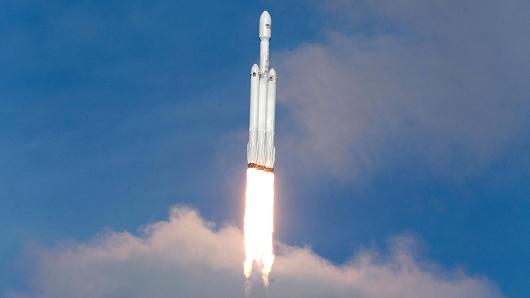
A SpaceX Falcon Heavy rocket lifts off from historic launch pad 39-A at the Kennedy Space Center in Cape Canaveral, Florida, U.S., February 6, 2018.
Success was never a certainty for Falcon Heavy’s maiden flight, as Musk noted previously that a “lot can go wrong” during a first attempt. The first few minutes of the launch were the most critical, as Musk said that once the rocket was beyond the Earth’s atmosphere and the upper stage deploys then SpaceX would be “in very well-known territory.”
Delays have plagued the development of the Falcon Heavy, a rocket that some in the space industry thought may never see launch day. Musk unveiled the rocket in 2011, promising the inaugural launch would happen as early as 2013.
SpaceX built Falcon Heavy out of three of the company’s Falcon 9 rockets — a system that has now completed dozens of successful launches over the last few years. The three cores stand side by side to create a 27-engine colossus. Musk has said the central core needed “to be buffed up a lot” but the Falcon 9 cores on each side “use most of the same airframe.”
At liftoff Falcon Heavy creates a combined 5 million pounds of thrust — or the equivalent of about 18 Boeing 747 airplanes at takeoff. Musk has called it the “most powerful rocket in the world by a factor of two,” and its payload is estimated to be nearly three times that of the former space shuttles.
When speculating on what would come after a successful test flight, Musk said that SpaceX “would be ready to do another Falcon Heavy flight pretty soon,” and added that it could be as quickly as 3 to 6 months away. The second Falcon Heavy launch would carry a commercial payload, Musk said.
Musk’s space company operates differently than any other by recovering the largest part of its Falcon 9 rockets — the first stage.





