
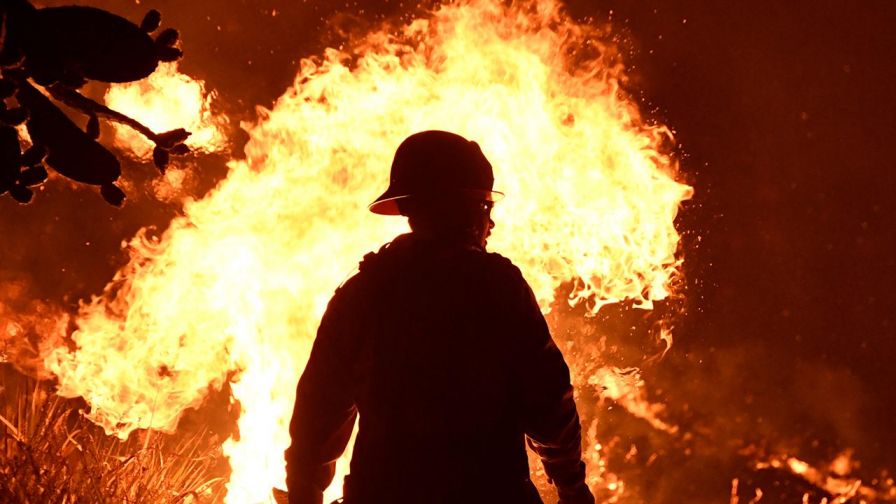
Thousands of people in Southern California were forced to evacuate on Tuesday as wind-whipped wildfires continued to blaze across Ventura County.
Officials said that the so-called “Thomas Fire,” which started Monday about 60 miles northwest of downtown Los Angeles, has caused 27,000 people to evacuate, destroyed at least 150 structures and has scorched more than 45,000 acres so far.
The cause of the fire is currently unknown.
No fatalities have been confirmed yet, Ventura County Fire Chief Mark Lorenzen said Tuesday. One unnamed firefighter has reportedly been injured. And three others were burned, the Los Angeles Times reported.
In light of the Thomas Fire, here’s what you need to know about California wildfires.
How do the fires start?
Roughly 95 percent of wildfires are caused by humans, Scott McLean, an information officer at the California Department of Forestry and Fire Protection, or Cal Fire, told Fox News.
A simple task — like mowing the lawn, throwing a cigarette butt out of a window, or parking a car on dry grass — can spark a fire, he said.
For instance, if a rock hits the lawn mower’s metal blades, that’s usually enough friction to create a spark that can ultimately start a fire, he said. And the heat from a car’s catalytic converter, a device that’s located underneath that controls its exhaust emissions, can reach up to 1,200 degrees Fahrenheit — enough heat to create a fire if the car is parked over dry, flammable grass.
“It only takes one spark to start a fire,” he said.
How are wildfires stopped?
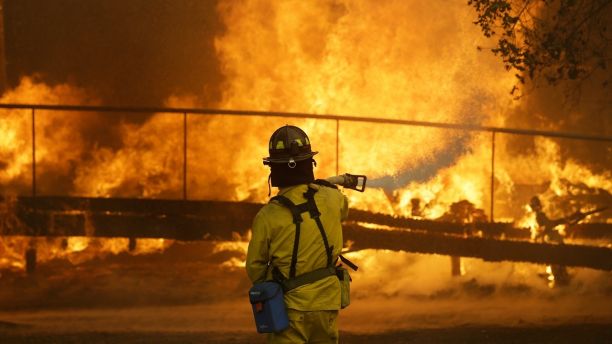
Officials are currently unsure what sparked the wildfires in Southern California.
(The Associated Press)
All wildfires can bring mass destruction. But the way each fire is stopped varies, McLean said.
In other words, “the different vegetation and different scenarios up and down the state” impact how each fire is handled.
“You don’t just throw resources at a wildfire,” he said. “It’s like a battle — you have to think what will be the most effective.”
Cal Fire usually depends on a mix of bulldozers, fire engines, inmate crews, and helicopters or airplanes, which disperse things like fire retardant, to stop wildfires.
Using containment lines, or large areas where a bulldozer cuts away vegetation to the point where only dirt remains, is very common, he said. But this isn’t always an accessible option.
“‘What would increase the fire’s speed, what would slow it down?,'” he asked. “Helicopter and airplanes are ineffective with winds over 30 miles an hour, and bulldozers can’t always get in there.”
Strong wind gusts also cause problems when putting out or controlling wildfires, he said. Regional atmospheric patterns that develop in the fall create dry, hot wind gusts that can sometimes reach 80 miles per hour. These winds can create so-called “spot fires” — which is when an ember from the main wildfire gets blown into a nearby bush or field, ultimately creating a second fire.
“It’s like a blowtorch,” he said.
Rain is typically welcome, as it can slow down or deter the fire, he said. But it can also create muddy conditions for bulldozers and fire crews which impacts how they can combat the blaze.
“It’s like a blowtorch.”
As for the Thomas Fire, however, McLean said resident safety comes first — hence the evacuation that took place on Tuesday. He added that Cal Fire is expecting more resources to come to the Ventura County area, adding that “several strategies and tactics are in place” to stop or control it.
“It’s a case by case basis, and it’s extremely fluid,” he said.
Why have California’s wildfires been so destructive recently?
McLean explained that California has faced a significant drought over the past five years, which created a lot of dead vegetation across the state. Like other mediterranean climates, winter time brings rain, which fills up water reserves and helps new vegetation to grow. California also had a record amount of rainfall in spring of 2017. But the summer’s heat dried out that new growth, and, combined with the autumn winds, means “a lot of fuel was created for wildfires,” he said.
The Santa Ana winds are currently pushing the Thomas Fire.
McLean said there are 102 million or more dead trees in California — all potential fuel for wildfires to blaze across the state.
“There’s a long road ahead of us. The fires we’ve dealt with recently — like the Thomas Fire — are all indicators of what we’re having to deal with in California for the next few years,” he said, adding that many of these fires have been wind-driven.
“Rains are not a cure all with one winter — it will take several years of winters to get moisture back into plants and reservoirs.”
Additionally, unlike tornados and hurricanes, wildfires don’t really have a season, McLean said. At this point, “there’s pretty much no fire season. It’s year round,” he said.
An impact on wine and entertainment
Wildfires could also impact the state’s wine industry from an economic standpoint, wine experts previously told Fox News. The California wine industry generates $57.6 billion in annual economic activity in the state and $114 billion in the country, according to statistics from the Wine Institute, a California-based public policy organization.
About 325,000 Californians are employed by the wine industry in California. The industry also contributes $17.2 billion in wages annually in the state.
Additionally, it generates $7.2 billion in tourism expenditures in California.

The wine industry can be affected by wildfires in California.
(The Associated Press)
What’s more, the Hollywood Reporter reported Tuesday that HBO suspended its second season of “Westworld” due to a 200-acre brush fire that broke out near where the show was filming.
Fox News’ Travis Fedschun contributed to this report.