
Prior to 1967, hiding one’s sexuality was not just a choice for gay men, but a necessity. Known gay men like Oscar Wilde (who was later imprisoned because of his sexuality) married women for social pretense, and psychiatrists offered dangerous conversion therapies to those desperate to alter their orientation.
As recently as 1954, journalist Peter Wildeblood received an 18-month prison sentence for “conspiracy to incite certain male persons to commit serious offenses with male persons.”
Many men developed sophisticated codes to coexist as queer in a world that criminalized their identities. Polari, a secret British slang used by gay men, for instance, allowed them to speak freely without the fear of arrest.
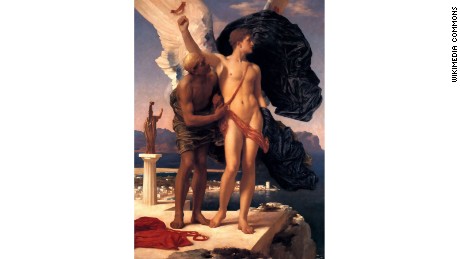
Gay artists (as well as artists believed to be gay) often explored homosexuality in academic guises, such as through Greek mythology. Frederick Leighton’s “Daedalus and Icarus” (c.1869) for example, hinted at the sexual relations between older mentors and young men in Ancient Greece, with the sexual subtext of an interracial gay couple.
It’s a coy reference to the Victorian Aesthetic Movement, whose members often used fashionable symbols to express their sexuality in everyday life. Props like peacock feathers and dyed green carnations were worn on jacket lapels, aesthetic signifiers that allowed gay men to identify themselves — and each other — without being caught.

In later years, the aesthetic became a public weapon. This was the very essence of Andy Warhol’s work in the 1960s. The artist gave mainstream imagery a queer twist, transforming photos of Elizabeth Taylor and Marilyn Monroe into Pop drag queens. As a gay man himself, Warhol was offering a space for queer audiences within the homophobic language of mainstream America.
“For me, they are places where masculinity can be examined, and I attempt to do this through my aesthetic and material choices,” Glass says. “The aesthetic of what I present is a surface under which a bigger conversation is taking place.”

Missing voices
The exhibition’s focus on white male artists is impossible to ignore, with women, trans people and people of color glaringly underrepresented.
The exhibition’s curator, Clare Barlow, confesses that, “we have been constantly frustrated by the comparative scarcity of material relating to intersectional identities: working-class queer lives, queer people of color, trans and genderqueer identities, even queer women artists.”

In the exhibition catalog, art historian Caroline Gonda explains that many of the works by and about women “abound with a sense of the hidden, the possible and the just-out-of-sight, whether in the realm of the visible/hidden body or the more distant realm of unseen desires, identities and relationships.”

Thankfully, contemporary artists are paving the way for queer women and people of color to ensure that future exhibitions like this have plenty of material to choose from.

“Dream Babes uses queer science fiction to imagine better futures and to create platforms and discussions now where they are lacking,” Sin says. “Representing this visually helps to immerse people into these speculative environments and set the tone for an event or performance.”
“Queer British Art (1861-1967)” guides us through the work of queer artists who used the aesthetic as both a secret language and a means of escape. As we move forward, let’s hope the exhibition inspires marginalized voices to build their own artistic shields, and challenge those who attempt to suppress them.