
Anton Vaganov | Reuters
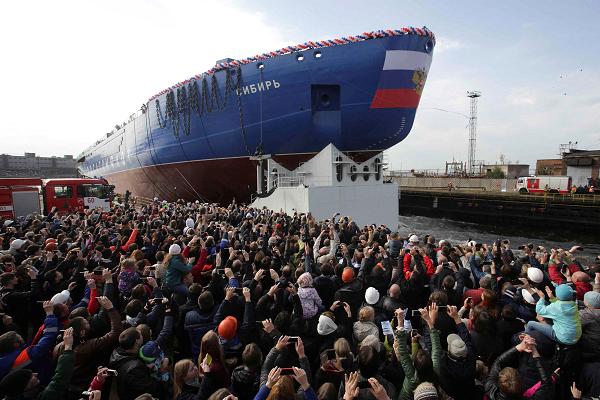
People attend a ceremony to float out the nuclear-powered icebreaker “Sibir” (Siberia), which is under construction, at the Baltic Shipyard in St. Petersburg, Russia September 22, 2017.
Energy resources will likely remain the driver of major investments in the Arctic for the foreseeable future, but for all the fanfare around them highly visible energy projects like Yamal LNG only paint a fraction of the economic picture in the Arctic, Pass says. Guggenheim’s Arctic project inventory includes a data center in Norway, a Finnish biomass-to-ethanol plant, and a Swedish lithium-ion battery factory, among many other projects that fall outside the more conventional categories of fossil fuels, mining, roads and railways.
But the greatest opportunity, he says, is arguably in transport — not just within the Arctic but through it. Much of the Arctic likely won’t see ice-free summertime shipping lanes for some time, perhaps two decades or longer. But other routes, like the Northern Sea Route along Russia’s northern shore are already navigable — albeit not easily — during certain times of the year, trimming some 30 percent to 40 percent off the distance ships would travel between East Asia and Northern Europe if they traversed the conventional Suez Canal route instead. Russia has already installed more than a dozen seaports along the route at places like Arkhangelsk and Murmansk, in the country’s northwest, to Tiksi and Pevek in the northeast.