

Venezuela’s constitutional assembly has ordered presidential elections by the end of April amid a rapidly-worsening economic crisis.
The proposal made by Diosdado Cabello, the deputy leader of the United Socialist Party of Venezuela, was approved unanimously by delegates during a raucous session Tuesday by the pro-government assembly. Cabello said voting was the best way to counter criticism by the administration of U.S. President Donald Trump and others that Venezuela is descending into dictatorship.
“If the world applies sanctions, we’ll apply elections,” said Cabello, referring to Monday’s decision by the European Union to impose financial and travel restrictions on him and six other top officials. “Nobody is going to come and give us lessons or tell us what to do….The Venezuelan people have the right to choose their own destiny.”
While President Nicolas Maduro is widely expected to seek re-election, Cabello, his main internal rival, didn’t explicitly endorse his likely candidacy. Nonetheless, he praised Maduro as the hand-picked successor of the late Hugo Chavez and said that the revolution would face no obstacles settling on a single candidate chosen by consensus among grassroots activists.
“We’re not going to have any problem,” he said to thunderous applause.
The order tasks the pro-government National Electoral Council with setting the precise date for the upcoming presidential vote.
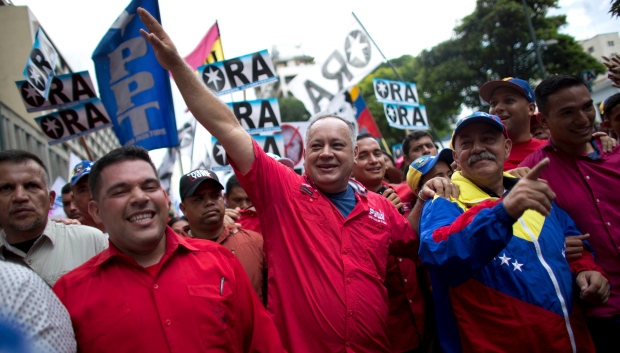
A proposal to Venezuela’s Constitutional Assembly by member Diosdado Cabello, centre, a leader of the ruling party, that presidential elections take place before the end of April, was passed. (Ariana Cubillos/Associated Press)
According to Venezuela’s constitution, a new six-year presidential term must begin in January 2019. While elections can be held any time before then, voting typically is held in the final three months of the year to avoid an extended transition.
Speculation has been growing in recent weeks that elections would be held earlier to take advantage of divisions within the opposition, which has been struggling to capitalize on growing discontent with Maduro.
Although polls show Venezuelans overwhelmingly blame Maduro for widespread food shortages and triple-digit inflation that has pulverized wages, the opposition was left rudderless as several prominent politicians were barred from office or forced into exile last year following a deadly protest movement seeking the president’s removal.
Compounding the opposition’s woes, several parties boycotted a recent election for mayors, leading the ruling socialist party to sweep the contest. The opposition alleged there weren’t enough guarantees the vote would be free and fair, but the partial boycott highlighted tensions over how best to confront Maduro, whose decision to create the all-powerful constitutional assembly alongside the opposition-controlled National Assembly has been condemned by several foreign governments, including the U.S. and Canada.

Opposition leader Henrique Capriles, who lost to Maduro by a thin margin in 2013, is barred from competing in the upcoming race over what he says are trumped-up charges of administrative improbity as a governor. (Fernando Llano/Associated Press)
Nonetheless, opposition leaders say they will field a single candidate to take on Maduro.
“Today, tomorrow, the next day: the only real truth is that this government and its ruling clic are abhorred by the immense majority of Venezuelans,” tweeted former presidential candidate Henrique Capriles, who lost to Maduro by a thin margin in 2013 but is barred from competing in the upcoming race over what he says are trumped-up charges of administrative improbity as a governor. “If our people are given the right to decide, they will have to leave.”






