
NOEL CELIS / AFP / Getty Images
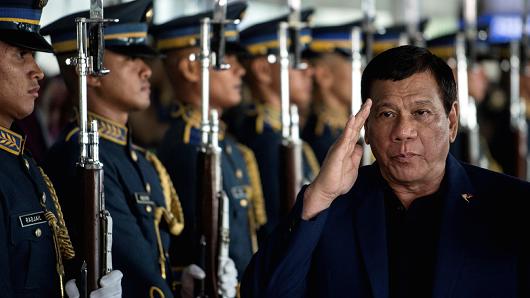
Philippine President Rodrigo Duterte walks past honor guards as he arrives at Manila international airport in Manila on May 24, 2017, after returning from a visit to Russia. Duterte threatened on May 24 to impose martial law in Mindanao to combat the rising threat of terrorism, after Islamist militants beheaded a policeman and took Catholic hostages while rampaging through a southern city.
The Philippines last experienced army rule under former dictator Ferdinand Marcos, whose 1972-1986 regime was synonymous with arbitrary arrests, detention, disappearances, and extrajudicial killings. “Martial law is martial law,” Duterte was quoted by media as saying on
Wednesday. “It will not be any different from what Marcos did. I’d be harsh.”
The president already faces widespread accusations of extrajudicial killings as well as silencing critics amid a campaign targeting drug users that has reportedly killed 7,000 to 8,000. And country-wide martial law could give Duterte a stronger platform to continue controversial
policies unchecked, according to strategists.
“Giving more powers to a president who is already being accused of human rights violations certainly raises anxiety for some groups,” stated Jean Franco, assistant professor at the University of the Philippines. “There are official statements from union leaders and rights groups
expressing unease and a throwback to Marcos’ martial law. The opposition in Congress has already expressed this.”
Martial law would basically entail military control of movement, searches and arrest of detained people as well as suspension of writ of habeas corpus, defense secretary Delfin Lorenzana explained on Tuesday.
“The alarm is very justified,” said Joseph Franco, research fellow at Singapore’s Nanyang Technological University. “Duterte has not even assuaged fears of Marcos-style martial law.”