
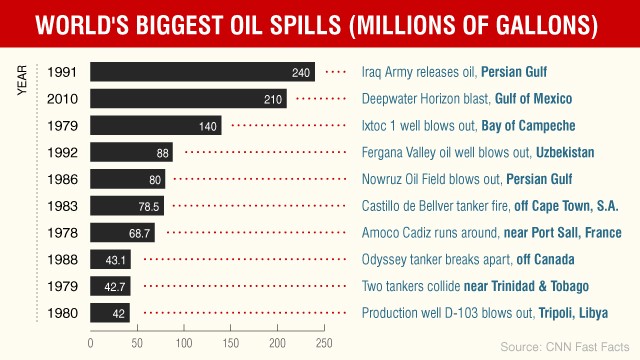
2. April 20, 2010 – An explosion occurs on board the BP-contracted Transocean Ltd. Deepwater Horizon oil rig, spilling approximately 210 million gallons of oil in the Gulf of Mexico.
3. June 3, 1979 – Ixtoc 1, an exploratory well, blows out, spilling 140 million gallons of oil into the Bay of Campeche off the coast of Mexico.
4. March 2, 1992 – A Fergana Valley oil well in Uzbekistan blows out, spilling 88 million gallons of oil.
6. August 6, 1983 – The Castillo de Bellver, a Spanish tanker, catches fire near Cape Town, South Africa, spilling more than 78 million gallons of oil.
7. March 16, 1978 – The Amoco Cadiz tanker runs aground near Portsall, France, spilling more than 68 million gallons of oil.
8. November 10, 1988 – The tanker Odyssey breaks apart during a storm, spilling 43.1 million gallons of oil northeast of Newfoundland, Canada.
9. July 19, 1979 – The Atlantic Empress and the Aegean Captain tankers collide near Trinidad and Tobago. The Atlantic Empress spills 42.7 million gallons of oil. On August 2, the Atlantic Empress spills an additional 41.5 million gallons near Barbados while being towed away.
10. August 1, 1980 – Production Well D-103 blows out, spilling 42 million gallons of oil southeast of Tripoli, Libya.
Notable US Oil Spills:
Union Oil Company
January 28, 1969 – Inadequate casing leads to the blowout of a Union Oil well 3,500 feet deep about five miles off the coast of Santa Barbara, California. About three million gallons of oil gush from the leak until it can be sealed 11 days later, covering 800 square miles of ocean and 35 miles of coastline and killing thousands of birds, fish and other wildlife.
Exxon Valdez
March 24, 1989 – The Exxon Valdez runs aground on Bligh Reef in Prince William Sound, Alaska, spilling more than 11 million gallons of oil.
March 22, 1990 – Captain Joseph Hazelwood is acquitted of all but one misdemeanor, negligent discharge of oil. Hazelwood is later sentenced to 1,000 hours of cleaning around Prince William Sound and is fined $50,000.
July 25, 1990 – At an administrative hearing, the Coast Guard dismisses charges of misconduct and intoxication against Captain Joseph Hazelwood, but suspends his captain’s license.
October 8, 1991 – A federal judge approves a settlement in which Exxon and its shipping subsidiary will pay $900 million in civil payments and $125 million in fines and restitution. Exxon says it has already spent more than $2 billion on cleanup.
September 16, 1994 – A federal jury orders Exxon to pay $5 billion in punitive damages to fishermen, businesses and property owners affected by the oil spill.
November 7, 2001 – The US Court of Appeals for the Ninth Circuit rules that the $5 billion award for punitive damages is excessive and must be cut.
December 6, 2002 – US District Judge H. Russel Holland reduces the award to $4 billion.
December 22, 2006 – The Ninth Circuit Court of Appeals reduces the award to $2.5 billion.
June 25, 2008 – The US Supreme Court cuts the $2.5 billion punitive damages award to $507.5 million.
June 15, 2009 – The Ninth Circuit Court of Appeals orders Exxon to pay $470 million in interest on the $507.5 million award.
BP Gulf Oil Spill
April 20, 2010 – An explosion occurs aboard BP-contracted Transocean Ltd Deepwater Horizon oil rig stationed in the Gulf of Mexico. Of the 126 workers aboard the oil rig, 11 are killed.
April 22, 2010 – The Deepwater Horizon oil rig sinks. An oil slick appears in the water. It is not known if the leak is from the rig or from the underwater well to which it was connected.
April 24, 2010 – The US Coast Guard reports that the underwater well is leaking an estimated 42,000 gallons of oil a day.
April 28, 2010 – The Coast Guard increases its spill estimate to 210,000 gallons of oil a day.
May 4, 2010 – The edges of the oil slick reach the Louisiana shore.
June 16, 2010 – BP agrees to create a $20 billion fund to help victims affected by the oil spill.
July 10, 2010 – BP removes an old containment cap from the well so a new one can be installed. While the cap is removed, oil flows freely. The new cap is finished being installed on July 12.
January 11, 2011 – The National Commission on the BP Deepwater Horizon Oil Spill and Offshore Drilling releases their full report stating that the explosion of the Deepwater Horizon rig launched the worst oil spill in US history, 210 million gallons.
January 26, 2012 – A federal judge in New Orleans rules that Transocean, the owner of the Deepwater Horizon rig, is not liable for compensatory damages sought by third parties.
September 30, 2013 – The second phase of the civil trial over the oil spill begins. This part focuses on how much oil was spilled and if BP was negligent because of its lack of preparedness.
December 18, 2013 – Kurt Mix, a former engineer for BP, is acquitted on one of two charges of obstruction of justice for deleting text messages about the oil spill.
September 4, 2014 – A federal judge in Louisiana finds that BP was “grossly negligent” in the run-up to the 2010 disaster, which could quadruple the penalties it would have to pay under the Clean Water Act to more than $18 billion. Judge Carl Barbier of the US District Court for the Eastern District of Louisiana also apportions blame for the spill, with “reckless” BP getting two thirds of it. He says the other two main defendants in the more than 3,000 lawsuits filed in the spill’s wake, Transocean and Halliburton, were found to be “negligent.”
January 20-February 2, 2015 – The final phase of the trial to determine BP’s fines takes place. The ruling is expected in a few months.
September 28, 2015 – In a Louisiana federal court, the city of Mobile, Alabama, files an amended complaint for punitive damages against Transocean Ltd., Triton Asset Leasing, and Halliburton Energy Services, Inc., stating that “Mobile, its government, businesses, residents, properties, eco-systems and tourists/tourism have suffered and continue to suffer injury, damage and/or losses as a result of the oil spill disaster.” As of April 20, 2015, Mobile estimated the losses had exceeded $31,240,000.
November 6, 2015 – The remaining obstruction of justice charge against Kurt Mix is dismissed as he agrees to plead guilty to the lesser charge of “intentionally causing damage without authorization to a protected computer,” relating to deletion of a text message, a misdemeanor. He receives six months’ probation and must complete 60 hours of community service.