

North Korea’s Kim dynasty: A timeline of nuclear weapons
Leaders of North Korea’s dynastic regimes: Kim Il-Sung, Kim Jong-Il and now Kim Jong-Un, all understood possessing nuclear weapons gave the Hermit Kingdom clout; but how exactly do their approaches towards nuclear weapons policies differ?
The threat of nuclear missile attack by North Korea is accelerating, U.S. Defense Secretary Jim Mattis said Saturday.
“North Korea has accelerated the threat that it poses to its neighbors and the world through its illegal and unnecessary missile and nuclear weapons programs,” he said, adding that U.S.-South Korean military and diplomatic collaboration thus has taken on “a new urgency.”
“I cannot imagine a condition under which the United States would accept North Korea as a nuclear power,” Mattis said.
Mattis made his remarks in Seoul alongside South Korean Defense Minister Song Young-moo. He pledged that the U.S. would repel any strike, adding that North Korea is overmatched by the firepower and cohesiveness of the decades-old U.S.-South Korean alliance.
“Make no mistake — any attack on the United States or our allies will be defeated, and any use of nuclear weapons by the North will be met with a massive military response that is effective and overwhelming,” Mattis added.
However, he also said that diplomacy is still the preferred way to deal with the North. Mattis’ comments come after a Japanese Defense Minister Itsunori Onodera recently said North Korea’s threat of nuclear war is now at an “unprecedented” level.
North Korean leader Kim Jong Un and U.S. President Donald Trump have engaged in a war of words that has only escalated over the past few months. Trump has nicknamed Kim “Rocket Man;” the North Korean leader has called Trump “deranged.”
The U.S. and its allies are on alert since North Korea tested intercontinental missiles in the Pacific near Japan and Guam, a highly strategic U.S. territory. Pyongyang conducted its longest-ever ballistic missile test flight last month.
And North Korea has previously warned other countries that participating in military actions with the U.S. could result in retaliation, especially as a “nuclear war may break any moment.”
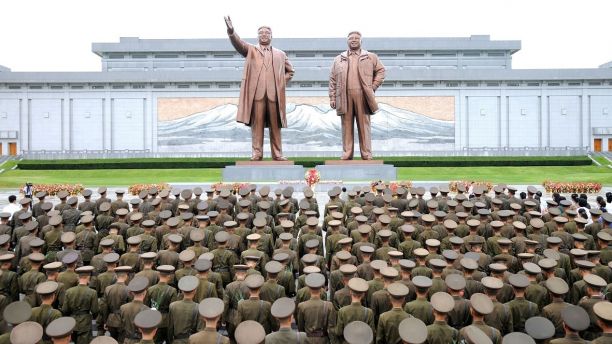
Kim Il Sung did not live long enough to see his country’s first successful nuclear weapons test. In this photo, members of the Korean People’s Army and the Korean People’s International Security Forces stand in front of a statue of Kim Il Sung and Kim Jong Il on the 72nd anniversary of national liberation.
(KCNA via Reuters)
“Unless the hostile policy and the nuclear threat of the U.S. is thoroughly eradicated, we will never put our nuclear weapons and ballistic rockets on the negotiation table under any circumstance,” North Korea ambassador Kim In Ryong reportedly told a United Nations disarmament committee.
Since Kim took over North Korea in 2011, it has rapidly expanded and tested its missile arsenal with weapons capable of striking the U.S. mainland. His end goal, he has reportedly said, is to “establish the equilibrium of real force with the U.S. and make the U.S. rulers dare not talk about military options” for the North.
Read on for a brief look at how North Korea’s nuclear weapons program has grown throughout the regimes in the past century.
Kim Il Sung, leader from 1948-1994
Kim Il Sung can be credited with founding North Korea and propelling the nation’s nuclear program forward — but he did not live to see his country conduct its first nuclear test.
It was under the first Kim that North Korea began to build up its nuclear reactors. And it was under his leadership that the nation began the Korean War — surely a catalyst that led the leader to believe his nation needed nuclear weapons, Dr. Sung-Yoon Lee, the Kim Koo-Korea Foundation Professor of Korean Studies at the Fletcher School at Tufts University, told Fox News in an interview.

Kim Jong Il was called the “dictator who turned North Korea into a nuclear state” after his death.
(Reuters)
TRUMP’S COMMENTS ON NORTH KOREA, FROM ‘FIRE AND FURY’ TO BLAMING CHINA
“The seeds of nuclear aspirations were sown in the Korean War,” Lee said.
The Korean War pitted North Korea and its ally China — two nations that did not have nuclear capabilities at the time — against a nuclear-armed U.S., making it “clear to the first Kim that nuclear weapons are very powerful, a powerful deterrent,” Lee said.
Kim Jong Il, leader from 1994-2011
When the second leader of the Kim dynasty died in 2011, Kim Jong Il was remembered as the “dictator who turned North Korea into a nuclear state,” in his New York Times obituary.
And it’s Kim Jong Il that really “gets the credit of taking the country down the nuclear path,” Lee said.
In the beginning of his reign — he was North Korea’s supreme leader from 1994 to 2011 — North Korea denied that it had a nuclear weapons program.
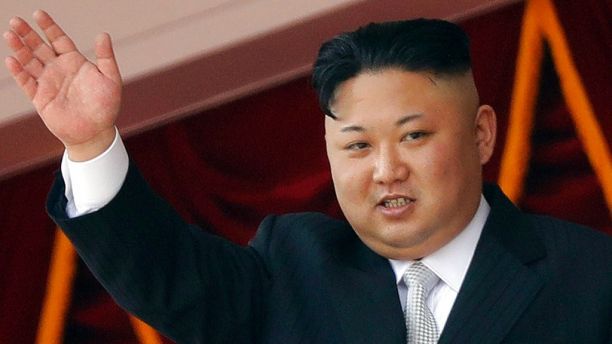
Kim Jong Un is credited with accelerating North Korea’s nuclear weapons program.
(AP Photo/Wong Maye-E)
JAPAN WARNS NORTH KOREA NUCLEAR THREAT AT ‘UNPRECEDENTED, CRITICAL’ LEVEL
However, in 2003, Pyongyang announced that North Korea was withdrawing from the 1968 Nuclear Nonproliferation Treaty, which barred the nation from making nuclear weapons.
By 2005, North Korea confirmed that it had its own nuclear weapons. It tested its first nuclear device in 2006.
Kim Jong Un, leader from 2011-present
Kim Jong Un is credited with accelerating North Korea’s push for nuclear weapons, and under the Obama administration, many of the world’s attitudes toward the East Asian nation’s nuclear capabilities became less blasé than in the past, Lee said.
And Kim Jong Un recently crossed a major threshold for his country this summer — the ability to credibly threaten the U.S. with an intercontinental ballistic missile.
NORTH KOREA CELEBRATES NUCLEAR TESTS
North Korea last month successfully tested its longest-ever flight of a ballistic missile. The intermediate-range weapon traveled 3,700 miles and passed over Japan before it landed in the Pacific. Earlier this month, the country also tested its most powerful nuclear test to date.
Defense Secretary Jim Mattis condemned the test and said it caused “millions of Japanese” to “duck and cover.” Mattis also said the U.S. and Japan are ready for potential future missile threats.
After the missile test, Kim Jong Un said North Korea is nearing “equilibrium” with the U.S. in terms of its military force.
The increasingly frequent and aggressive tests have added to outside fears that North Korea is closer than ever to building a military arsenal that could viably target the mainland of the U.S. or its allies in Asia.
Trump called Kim Jong Un “Rocket Man” in his speech to the U.N. last month and said the dictator is on a “suicide mission for himself and for his regime.”
“The United States has great strength and patience,” Trump said. “But if it is forced to defend itself or its allies, we will have no choice but to totally destroy North Korea.”
The Associated Press contributed to this report.