
The impact in western Syria came at around 8:45 p.m. ET. The impact globally likely won’t be known for hours and days. Not until the sun comes up and the dust lifts near the Shayrat airbase in the civil war-scarred country’s west, where more than 50 Tomahawk missiles struck Thursday night at the directive of U.S. President Donald Trump.
For now, Mideast and security experts say, it appears the tactical retaliatory strike against the regime of Syrian President Bashar al-Assad — the first direct military assault against Assad by the U.S. since the start of the six-year civil war — was a one-time attack, ordered a day after Assad unleashed a sarin gas attack that killed an estimated 70 people and was denounced as a war crime by human rights groups.
But even in the fog of war, it could be a clarifying moment for Trump, a president who has over the course of the last two days reversed the non-interventionist doctrine that has been a hallmark of his foreign policy position since his campaign for president.
Trump’s action stands in opposition to Obama
The president, who spoke of being moved by images of dying children, accused Assad of having “choked the lives of helpless” Syrians.
“No child of God should ever suffer such harms,” Trump told reporters in a statement from his Mar-a-Lago estate in Florida. “Tonight, I ordered a targeted military strike on the airfield in Syria from where the chemical attack was launched.”
It was a sobering declaration from the president, even if it was politically self-serving one, said Henri Barkey, director of the Middle East program at the Wilson Center in Washington, D.C.

The guided-missile destroyer USS Porter (DDG 78) launches a Tomahawk land attack missile in the Mediterranean Sea. (Mass Communication Specialist 3rd Class Ford Williams/U.S. Navy/Associated Press)
“A no-brainer. It was win-win for him in many ways,” said Barkey, who argues Trump’s action move works on many fronts.
Not only will the aggressive gunboat diplomacy rattle Assad, the Mideast specialist said, but it will intimidate the Syrian government against the further use of chemical weapons and possibly enable Trump to reclaim the moral high ground on the world stage, all the while allowing him to show that his actions are not dictated by the interests of the Russians, who have militarily supported Assad’s war against opponents of his regime.
Donald Trump on airstrikes against Syria2:50
“The main thing is Trump gets to say, ‘Look, I did what [former president] Barack Obama couldn’t do’ because this has as much to do with Obama than anything else,” Barkey said.
Obama, Trump’s predecessor, declared in 2012 that the use of chemical weapons by the Assad regime would cross a “red line” warranting military force. But when the time came to turn moral outrage into action, Obama said he would seek approval from a skeptical Congress for a military strike in Syria. It never came to that because the Assad regime agreed to give up its stockpile of chemical weapons (whether that was ever true is no in question).
At the time, Trump, who at the time was toying with seeking the Republican nomination for president, tweeted his objection to a strike in Syria.
Strike deflects attention from domestic crises
Trump, for his part, authorized the use of force on Thursday without seeking congressional approval. He may have to answer for that later in Washington, but he will reap some short-term benefits.
Republican senators John McCain and Lindsey Graham, vocal critics of the president, lauded him in a statement on Thursday, saying it was time to expand the war to support Syria’s rebel fighters against Assad’s forces.

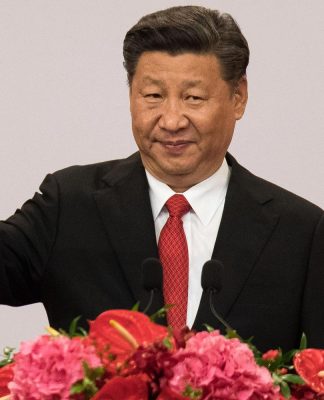
Trump, right, was meeting with Chinese President Xi Jinping at his Florida estate, Mar-a-Lago, shortly before he ordered the attack. (Alex Brandon/Associated Press)
The military strike will also likely deflect attention from Trump’s domestic crises, which include:
- The recusal of House intelligence committee chairman Devin Nunes from the investigation into the Trump administration’s ties to Russia on account of ethics concerns;
- Infighting between the president’s top White House advisers Steve Bannon and Jardon Kushner, Trump’s son-in-law;
- The ejection of Bannon from the National Security Council.
‘You cannot argue that the timing of this action, while having dinner with Xi, was quite smart.’
– Henri Barkey, director, Middle East program, Wilson Center
And then there is the matter of whom Trump was meeting with shortly before the missile strike was launched. On Thursday, he was hosting Chinese President Xi Jinping in Florida on the first day of a two-day summit. The fact that Xi was present at the time of the strike created a diplomatic situation that de facto “boxed in” the Chinese, Barkey said, and prevented a potentially public and personal diplomatic spat at the high-stakes meeting.
“The Chinese are not going to come out then and condemn the U.S. action,” Barkey said. “So you cannot argue that the timing of this action, while having dinner with Xi, was quite smart.”
Syria may wage propaganda war
The question of whether or not this action will cause escalation depends on the response of the Russians and Iranians, who have supported Assad’s regime militarily.
In a Pentagon statement, defence officials stressed that Russians fighter jets were forewarned via an “established deconfliction” hotline to evacuate the strike zone.
“Whatever you do,” Barkey said, “you don’t want to kill Russians.”
He noted that the likelihood of collateral damage from Tomahawk missiles is fairly small because of their sophisticated guidance systems. But just because civilians aren’t likely to be near the Shayrat airfield doesn’t mean a propaganda war won’t be waged through Syrian state TV, Barkey said.
Tomahawk missiles fired from U.S. warship in the Mediterranean Sea0:45
“It’s very possible in the morning we’re going to see pictures of dead or injured children, and they might say, ‘See what the Americans did?'” he said.
One retaliatory option the Assad government has is to target some of the more than 1,000 American troops currently deployed in Syria, mainly near Raqqah, where they are assisting Syrian rebels fighting ISIS.
Attack might deter ‘bad actors’
Regardless, the launching of “fire-and-forget-it” Tomahawk missiles was a raw display of American military might that can’t be discounted for the deterring message it sends, said Jonathan Schanzer, a former counter-terrorism analyst with the U.S. Department of Treasury who now directs research at Washington’s Foundation for Defence of Democracy.
A “proportional” U.S. military response in Syria was “long overdue” after six years of protracted civil war, he said.
“Bad actors have had free rein in terms of regional actions, war crimes and such, so this might have had the effect of freezing them in their tracks … and that would be a welcome development,” he said.
Though Schanzer said “it’s not just early days, it’s early hours” the attack signaled a major foreign-policy sea change from a presidency that indicated only a week earlier it had little interest in unseating the Syrian dictator.
“I don’t believe Trump thought for a moment that the carnage in Syria, and war crimes by Assad, would prod him to action,” he said.
“Will this be one of those defining moments that could alter the course of his presidency? It will be interesting to find out.”
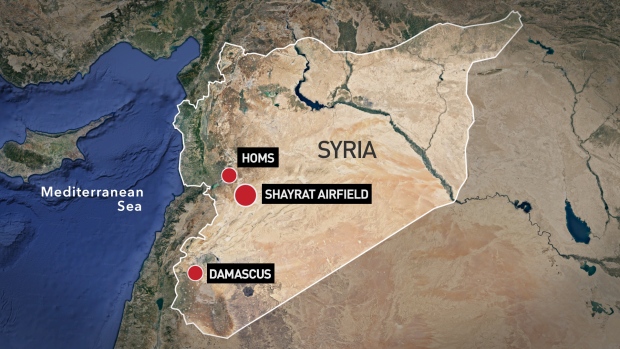
The airstrike early Friday local time in Syria targeted the Shayrat military airbase in Homs. (CBC)