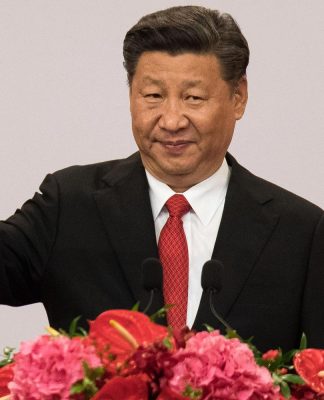


As President Donald Trump’s promotes his “America First” foreign policy, Xi has taken the opportunity to project himself as a champion for global goals. But China is definitely not building up the liberal world order.
“The contrast with the U.S. provides Xi a rhetorical opportunity to be an advocate for globalization, but it’s the style of globalization with government intervention,” said Scott Kennedy, a China expert at the Center for Strategic and International Studies.
Last week, Xi expressed support for market reform and private firms at the opening of the party congress, but at the same time he also called for a strong government presence in the economy.
“This is an illiberal world that China is trying to build and it doesn’t look like the world that Deng tried to bring China into in the 1980s and 90s,” Kennedy told CNBC on Wednesday, referring to late Chinese leader Deng Xiaoping, the architect of the country’s economic reforms.
On Tuesday, the Chinese Communist Party approved an amendment to include Xi’s name and his doctrine into its constitution. In effect, anyone who now challenges Xi is challenging the party itself.
Xi is only the third leader after Mao Zedong, founder of Communist China, and Deng, to have his name enshrined into the document, so the move is “enormously symbolic,” said Merriden Varrall, director of East Asia Program for Lowy Institute for International Policy in Australia.
“It indicates that he has that kind of power that Mao had as the creator of the new China, that Deng Xiaoping had as the reformer, and he’s the rejuvenator, so he’s the symbolic entity who is going to take China to the next level,” Varrall told CNBC.
Under Xi’s watch in the last five years, China’s global influence has expanded. The world’s second-largest economy is pushing ahead with the Belt and Road Initiative, a trading network evoking the ancient Silk Road. The cross-continent project promises vast investment in infrastructure and new opportunities for countries along the route.
— Reuters contributed to this report.