

Centrist Emmanuel Macron and far-right leader Marine Le Pen are set to face each other in a May 7 runoff for the French presidency after coming first and second in Sunday’s first round of voting, early projections indicated.
In a race that was too close to call up to the last minute, Macron, a pro-European Union ex-banker and economy minister who founded his own party only a year ago, was projected to get 24 per cent by the pollster Harris and 23.7 per cent by Elabe.
Le Pen, leader of the anti-immigration and anti-EU National Front, was estimated to have taken 22 per cent by both institutes. Three further pollsters all projected broadly similar results.
Turnout figures were at 69.42 per cent of eligible voters a few hours before polls were set to close, slightly down from the last election.

François Fillon, left, Emmanuel Macron, Jean-Luc Mélenchon and Marine Le Pen were in a tight race in the first round of the French presidential election. (Patrick Kovarik/Pool/Reuters)
Le Pen’s spot in the runoff is seen as a victory for the rising wave of populism reflected by the votes for U.S. President Donald Trump and Brexit — the British departure from the European Union.
Trump weighed in on the campaign on Friday, expressing support for the Le Pen, saying she is “strongest on borders, and she’s the strongest on what’s been going on in France.”
And it sets up a race similar to the contest in the U.S., with a populist outsider vying against a centrist, albeit of an unusual political stamp, which may mean some surprises in the election process.
Though Macron, 39, is a comparative political novice who has never held elected office, opinion polls in the run-up to the ballot have consistently seen him easily winning the final clash against Le Pen.
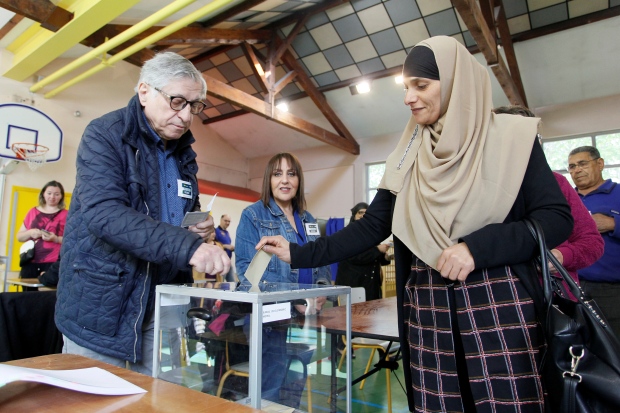
Voters cast ballots at a polling station in Vaulx-en-Velin near Lyon, France. (Emmanuel Foudrot/Reuters)
Defeated Socalist candidate Benoît Hamon urged voters to rally behind Macron in the second round, as did senior conservative lawmaker François Baroin, from the camp of defeated right-wing candidate François Fillon.
Harris gave both Fillon and far-left contender Jean-Luc Mélenchon 20 per cent, which will mean their elimination from the race.
Fillon had consistently been polling third in surveys leading up to the election. French senator and key Fillon supporter Roger Karoutchi told reporters: “The first indications are not good.”
France heads to the polls in closely watched election1:33
Contrasting economic visions
The result, if confirmed, will mean a face-off between politicians with radically contrasting economic visions for a country whose economy lags that of its neighbours and where a quarter of young people are unemployed.
That in turn reduces the prospect of an anti-establishment shock on the scale of Britain’s vote last June to quit the EU and the election of Donald Trump as U.S. president.
Early indications from Reuters data showed the euro currency jumping to a four-week high around $1.09 US in response to the early projections, up from $1.0726.
Macron favours gradual deregulation measures that will be welcomed by global financial markets, while Le Pen wants to ditch the euro currency and possibly pull out of the EU.
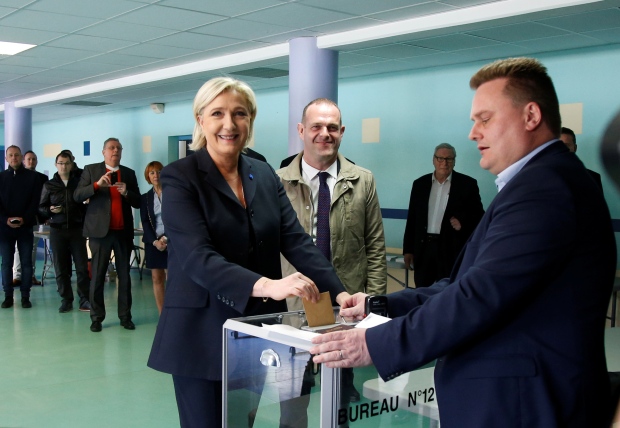
Marine Le Pen, leader of France’s far-right party Front National, casts a ballot in Henin-Beaumont in northern France. Le Pen will challenge Macron for the presidency. (Charles Platiau/Reuters)
Redrawing France’s political landscape
Whatever the outcome on May 7, it will mean a redrawing of France’s political landscape, which has been dominated for 60 years by mainstream groupings from the centre-left and centre-right, both of whose candidates faded.
Macron ally Gerard Collomb said the defeat of the mainstream centre-left Socialists and the centre-right Republicans showed a “deep malaise” in French society.
The final outcome on May 7 will influence France’s standing in Europe and the world as a nuclear-armed, veto-wielding member of the UN Security Council and founding member of the organisation that transformed itself into the European Union.
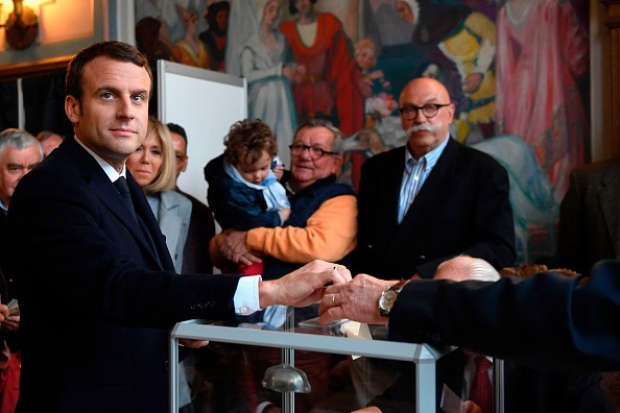
French presidential election candidate for the En Marche! movement Emmanuel Macron, left, casts his ballot at a polling station in Le Touquet in northern France. He took the most votes in the first round, pollsters say. (Eric Feferberg/AFP/Getty Images)
Tight security
Ballots for the presidential election were cast under heightened security. Over 60,000 polling stations opened for voters who chose between 11 candidates in the most unpredictable election in decades.
Security was tight after a deadly attack on the Champs Elysée on Thursday in which a police officer and a gunman were slain. The government has mobilized more than 50,000 police and gendarmes to protect polling stations, with an additional 7,000 soldiers on patrol.
It’s the first time in living memory a presidential election is taking place during a state of emergency, which was put in place after the Paris attacks of November 2015.
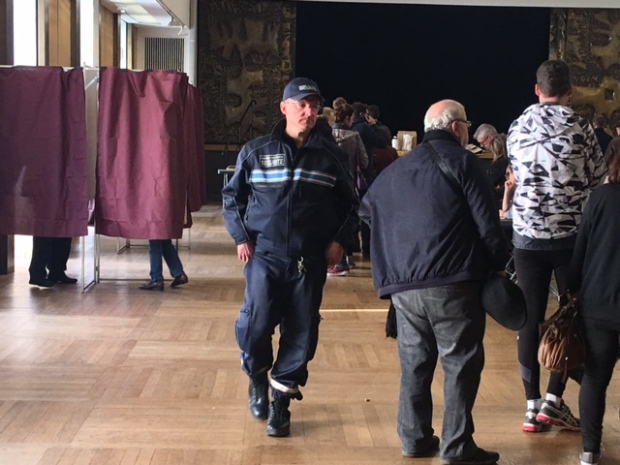
Soldiers were deployed across France to ensure voting went safely. Inside this polling station in central Paris, a private security employee watches as people cast ballots. (Nahlah Ayed/CBC)