

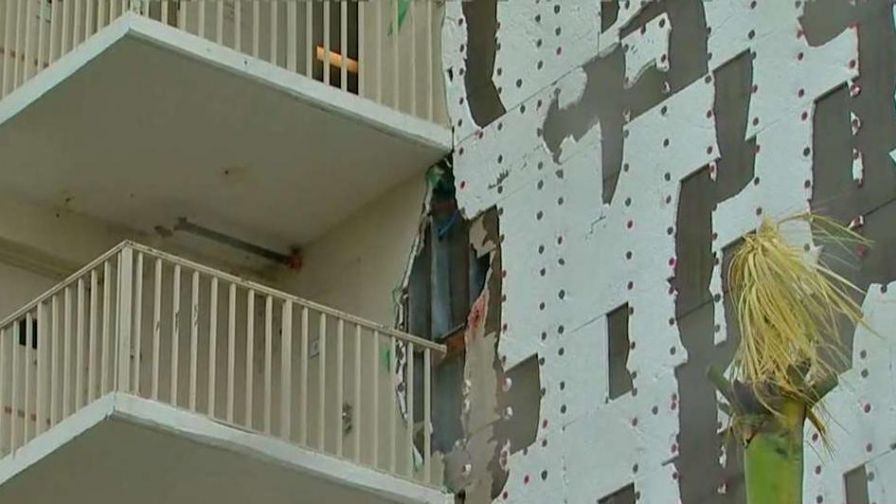
Deadly Hurricane Maria regained major hurricane status early Thursday, strengthening to a Category 3 storm, as it left a devastated — and completely powerless — Puerto Rico in its wake.
The strongest hurricane to hit Puerto Rico in more than 80 years left the entire island without electricity, making it difficult to assess just how many damage was caused by Maria’s unrelenting onslaught. The storm, with winds of 115 mph and traveling northwest at 9 mph, is now headed for the northeastern Dominican Republic and Turks and Caicos. It was centered about 55 miles north of Punta Cana in the Dominican Republic early Thursday morning.
“Once we’re able to go outside, we’re going to find our island destroyed,” said Abner Gomez, Puerto Rico’s emergency management director. “The information we have received is not encouraging. It’s a system that has destroyed everything in its path.”
The storm is deemed responsible for 10 deaths so far: two people in Guadeloupe, seven in Dominica and one in Puerto Rico. That toll is expected to rise.
Uprooted trees and widespread flooding blocked many highways and streets across the island, creating a maze that forced drivers to go against traffic and past police cars that used loudspeakers to warn people they must respect an overnight curfew imposed by the governor to ensure everyone’s safety.
Maria hit Puerto Rico as a Category 4 storm, weakened to a Category 2 as it tore through the island and then regained strength with the Dominican Republic in its sights.
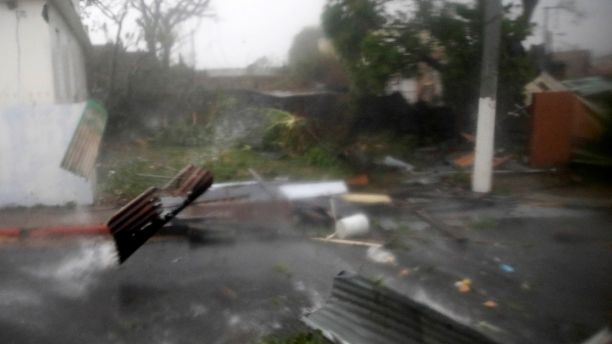
Constructions debris are carried by the wind after the area was hit by Hurricane Maria in Guayama, Puerto Rico.
(Reuters)
The hurricane was still dumping rain overnight Wednesday in Puerto Rico, where crumbled red roof tiles lay scattered across many roads, and curious residents ducked under dozens of black power lines still swaying in heavy winds. More than 11,000 people — and more than 580 pets — were in shelters, authorities said.
In the island’s capital of San Juan, eucalyptus trees fell nearly every other block over a main road dotted with popular bars, restaurants, and coffee shops, some of which were damaged.
Outside a nearby apartment building, 40-year-old tourism company operator Adrian Pacheco told the Associated Press how he spent eight hours in a stairwell huddled with 100 other residents when the hurricane ripped the storm shutters off his building and decimated three balconies.
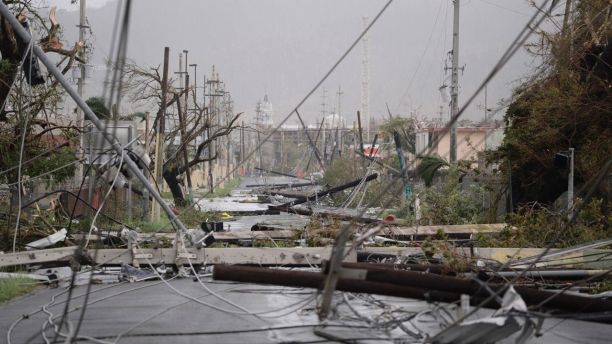
Electricity poles and lines lay toppled on the road after Hurricane Maria hit the eastern region of the island, in Humacao, Puerto Rico.
(AP)
“I think people didn’t expect the storm to reach the point that it did,” he said. “Since Irma never really happened, they thought Maria would be the same.”
Officials are unable to say when electricity would return on the island, which was already crumbling amid lack of maintenance and a dwindling staff even before the Hurricanes Irma and Maria knocked out power. Many now believe it will take weeks, if not months, to restore power.
On the northern part of the island, the mayor of one coastal town said he received reports of one area losing 80 percent of the homes in the area.
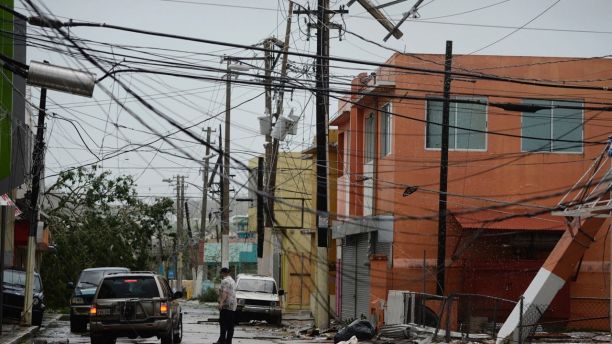
Power lines are down after the impact of Hurricane Maria, which hit the eastern region of the island in Humacao, Puerto Rico.
(AP)
Catano Mayor Felix Delgado said the small fishing community near the San Juan Bay was inundated with more than 4 feet of storm surge from Maria.
Delgado told ElNuevoDía.com “this generation is going to play to build the new Catano.”
As of now, Maria poses no immediate threat to the U.S. mainland. The long-range forecast showed the storm out in the Atlantic Ocean hundreds of miles off the Georgia-South Carolina coast by Monday morning.
The Associated Press contributed to this report.

Hurricane Maria’s forecast track.
(MyForHurricane.com)






