
A Gulf of Mexico storm rapidly intensified early on Friday spinning into potentially the biggest hurricane to hit the mainland United States in 12 years and taking aim at the heart of nation’s oil refining industry.
Hurricane Harvey strengthened to a category 2 storm, packed winds of 160 km/h as it moved northwest about 355 km/h off the coast of Corpus Christi, Texas, the National Hurricane Center said in an advisory.
The storm is forecast to make landfall late Friday or early Saturday, packing winds of up to 201 km/h. The storm could bring a surge in sea levels as high as 3.7 metres and dump up to 97 cm of rain over parts of Texas.
Flood warnings are in effect for northern Mexico and Louisiana. The threat has triggered evacuations and cancelled the first day of school in communities along the south Texas coast, which is home to 5.8 million people from Corpus Christi to Galveston.
“Life-threatening and devastating flooding expected near the coast due to heavy rainfall and storm surge,” the hurricane centre said.
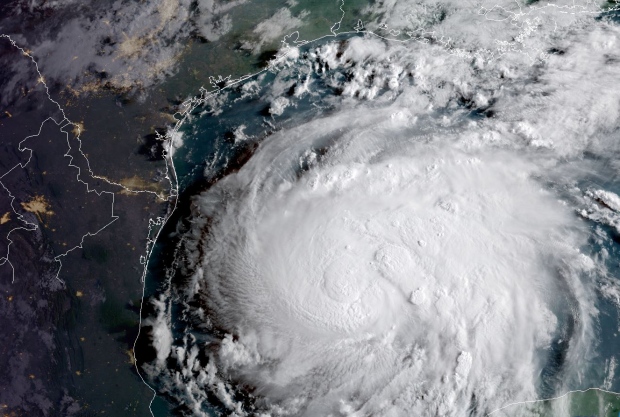
Hurricane Harvey is seen in the Texas Gulf Coast, U.S., in this NOAA satellite image taken on August 24. (NOAA/Reuters)
Energy companies shut coastal refineries, pulled workers from Gulf of Mexico offshore oil platforms and halted onshore drilling in south Texas on Thursday. Just under 10 per cent of offshore U.S. Gulf of Mexico crude output capacity and nearly 15 per cent of natural gas production was halted by midday, government data showed.
Harvey is forecast to come ashore as a category 3 hurricane, the U.S. National Hurricane Center said, which would make it the first major hurricane to hit the mainland U.S. since Hurricane Wilma struck Florida in 2005.