

Joe Raedle | Getty Images News | Getty Images
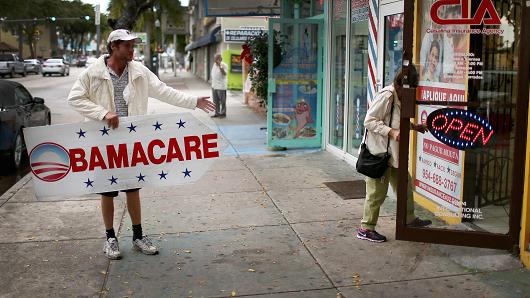
Pedro Rojas holds a sign directing people to an insurance company where they can sign up for the Affordable Care Act, also known as Obamacare, before the February 15th deadline on February 5, 2015
AshLee Strong, a spokeswoman for House Speaker Paul Ryan, R-Wisconsin, told NBC News: “We are now at the culmination of a years-long process to keep our promise to the American people.”
A draft bill obtained by NBC News would repeal much of the current law, also known as Obamacare, within the next few years and set in place a Republican vision of health care.
The draft legislation would provide expanded tax credits and health savings accounts for individuals while reducing federal spending on tax subsidies and Medicaid and practically eliminating the employer and individual mandates to provide and carry health insurance.
It wasn’t clear Sunday night to what extent the draft legislation, dated Feb. 10, may have changed in the last three weeks, but at the time, an aide to a House Republican said: “This is the bones of what’s going to happen.”
President Donald Trump met with health insurance chief executives at the White House last week to try to win their support for the Republican revamp.
More from NBC News
Donald Trump Expected to Sign New Immigration Order: A Timeline
FBI Director Comey Asked Justice Department to Reject Trump’s Wiretap Claims
Analysis: The Quiet Response to President Trump’s Explosive Claim
Only 12 percent of Americans said they had a “great deal” or “quite a bit” of confidence in health insurance companies in a NBC News/Wall Street Journal poll in December. In contrast, 54 percent said they had “very little” or “none at all.”
Under the draft bill, Americans who need assistance to buy health care would receive a tax credit — with an option to receive it in advance on a monthly basis — based on age. A person under 30 would be eligible for a $2,000 tax credit, while a person over 60 would be eligible for a $4,000 credit.
The measure would also create state-based high-risk pools for people who don’t have access to insurance. The federal government would start providing $15 billion to help fund the high-risk pools next year, but the funding would decrease to $10 billion by 2020 and beyond.
And the legislation would greatly expand the use of health savings accounts, a tax-deductible way to buy health insurance, which has become a top Republican priority.
The largest funding mechanism would be a tax on the most expensive employer-provided health insurance plans.





