
Large swathes of Venezuela’s capital were shuttered and silent Thursday as opponents of President Nicolas Maduro called the first major national strike since a 2002-03 stoppage that failed to topple Maduro’s predecessor Hugo Chavez.
A public transport strike appeared to have halted nearly all bus traffic and thousands of private businesses defied government demands to stay open. State-run firms were open, though many were short on staff after employees failed to appear. Improvised roadblocks closed many streets.
The 24-hour strike was meant as an expression of national disapproval of Maduro’s plan to convene a constitutional assembly that would reshape the Venezuelan system to consolidate the ruling party’s power over the few institutions that remain outside its control. The opposition is boycotting a July 30 election to select members of the assembly.
“Definitively, we need a change,” said teacher Katherina Alvarez. “The main objective is for people to see how dissatisfied people are.”
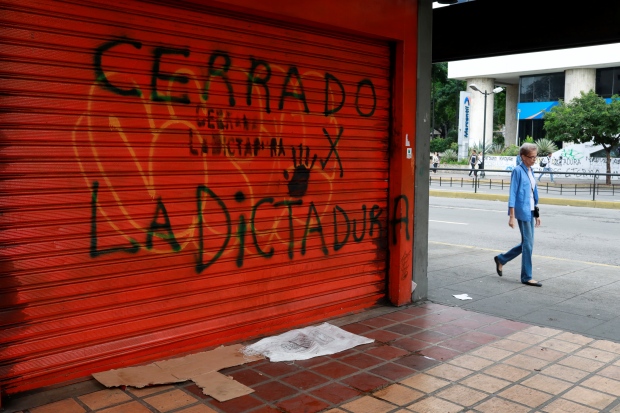
A woman walks on a street close to graffiti that reads ‘closed because of the dictatorship’ in Caracas. (Marco Bello/Reuters)
The country’s largest business group, Fedecamaras, has cautiously avoided full endorsement of the strike, but its members have told employees that they won’t be punished for coming to work. Fedecamaras played a central role in the months-long 2002-03 strike that Chavez’s political rivals and opponents in Venezuela’s private business sector orchestrated in an attempt to topple him.
“This is a work stoppage by civil society. He who wants to work, work. Who wants to stop, stop,” said Francisco Martinez, the president of Fedecamaras.
Chavez emerged from the previous strike and exerted control over the private sector with years of expropriations, strict regulations and imports bought with oil money and meant to replace local production. Business groups estimate that 150,000 Venezuelan businesses have closed over the last 15 years. The opposition also called a 12-hour national strike last year that saw little response and was widely seen as a failure.
Government-run industries will remain open and Labour Minister Nestor Ovalles said the Maduro administration would punish private companies that close in sympathy with the strike.
“We won’t allow, and we’ll be closely watching, any disruption that violates the working class’ right to work,” Ovalles said. “Businesses that join the strike will be punished.”
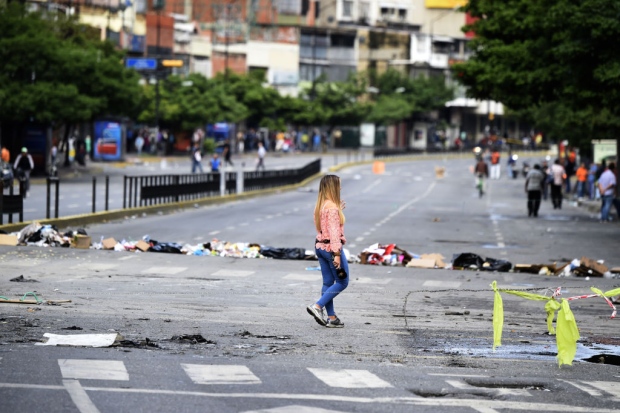
Demonstrators block an avenue in Caracas. Neighbourhood groups across the capital set up roadblocks of tree branches and tires to protest Maduro’s plans to change the constitution. (Juan Barreto/AFP/Getty Images)
The Venezuelan Workers’ Confederation, a labour coalition with ties to the opposition, said at least 12 of its 20 member organizations across the country had joined the strike. Transportation workers in the capital, Caracas, also said they would participate.
“There’s an appeal to the conscience of the Venezuelan people,” said Pedro Jimenez, head of a major transport workers’ union. “There won’t be transportation services.”
Some residents were irritated that neighbourhood groups across Caracas set up roadblocks of tree branches and tires to protest Maduro’s plans to change the constitution.
“The government jails the people who protest and those who are protesting are caging the rest of us. It’s unfair,” said Maria Sandoval, a 27-year-old medical secretary.
But those at the roadblocks said they had no plans to stop until Maduro leaves power.
“The people don’t want this government,” accountant Wilfredo Villegas said as he manned a roadblock with neighbours Thursday morning. “We’re here making them understand that we don’t want this government. They have to go, in a non-violent way. They have to call general elections.”

An opposition activist wears a Guy Fawkes mask during a protest on Tuesday. (Ronaldo Schemidt/AFP/Getty Images)