
U.S. President Donald Trump is in Puerto Rico today to meet with some of the 3.4 million people struggling to recover from Hurricane Maria amid criticism the federal government’s response has been sluggish.
The president was expected to spend more than five hours on the island, meeting with first responders, local officials and some of the residents struggling to recover from a hurricane that, in Trump’s words, left the island U.S. territory “flattened.”
Trump thanked FEMA administrator Brock Long, Puerto Rico Gov. Ricardo Rossello, congresswoman Jenniffer Gonzalez-Colon and other officials working on hurricane response.
Gonzalez-Colon said the collaborative effort both before Maria and after the storm hit was a major help.
‘We’ve saved a lot of lives’
The president said the governor has been “tremendously supportive” and knew the extent of the problems on the island.
“This governor did not play politics, he did not play it at all,” Trump said.
As the meeting went on, Trump introduced and praised many of the officials who had gathered for the briefing, including budget director Mick Mulvaney.
“Now, I hate to tell you, Puerto Rico, but you’ve thrown our budget a little out of whack because we’ve spent a lot of money on Puerto Rico and that’s fine. We’ve saved a lot of lives.”
Trump said “every death is a horror, but if you look at a real catastophe like Katrina and you look at the tremendous hundreds and hundreds and hundreds of people that died, and you look at what happened here with really a storm that was totally overpowering … you can be very proud of all of your people, all of our people working together.”
The governor said the death toll in Puerto Rico stands at 16. According to the U.S. Weather Service, Katrina was responsible for 1,833 deaths.
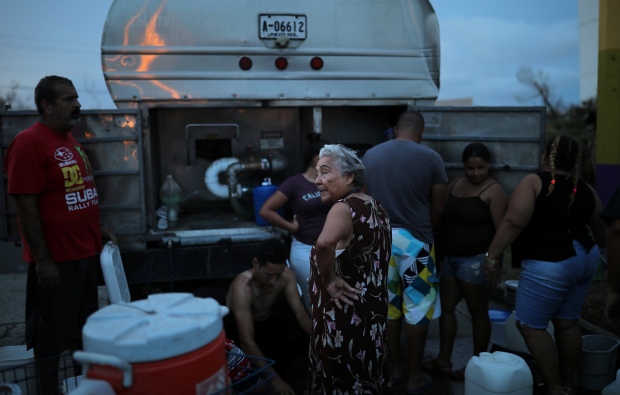
Local residents wait in line during a water distribution earlier this week in Las Piedras, Puerto Rico. The U.S. president, who has faced criticism from some over the response to the powerful hurricane, is on the island today. (Carlos Barria/Reuters)
Trump’s visit follows a weekend in which he aggressively pushed back against critics, including San Juan Mayor Carmen Yulin Cruz.
Trump responded angrily on Twitter, deriding the “poor leadership ability by the Mayor of San Juan, and others in Puerto Rico, who are not able to get their workers to help.”
“They want everything to be done for them when it should be a community effort,” he added, scoffing at “politically motivated ingrates” who had criticized the federal work, and insisting that “tremendous progress” was being made.
Cruz had accused the administration of “killing us with the inefficiency” and begged the president to “make sure somebody is in charge that is up to the task of saving lives.”

Ignacio Maldanado Ortiz relaxes in a hammock in Corozal, Puerto Rico, while hooked up to an oxygen machine due to his emphysema. He needs oxygen but has no way of getting a supply in the aftermath of Hurricane Maria. (Joe Raedle/Getty Images)
Valentine Navarro, 26, a salesman in San Juan, shrugged off Trump’s trip as a public relations exercise.
“I think he’s coming here because of pressure, as a photo-op, but I don’t think he’s going to help more than he has already done and that’s not much,” Navarro said.
After he meets with survivors of the disaster at an undisclosed location, Trump will take a helicopter tour to look at the destruction. He is expected to fly over the USNS Comfort, the just-arrived hospital ship.
Before the president left for Puerto Rico, he said “in Texas and in Florida, we get an A-plus, and I’ll tell you what, I think we’ve done just as good in Puerto Rico, and it’s actually a much tougher situation.”
Trump said before he arrived on the island Tuesday that Cruz has “come back a long way” in her criticism, noting the recent moderation in her remarks. He added: “The first responders, the military, FEMA, they have done an incredible job in Puerto Rico. And whether it’s her or anybody else, they’re all starting to say it.”
Initial reports said Cruz would attend events with Trump on Tuesday, but as the day unfolded it wasn’t immediately clear whether that would happen.
Frantic hurricane season
The trip will be Trump’s fourth to a region battered by storms during an unusually violent hurricane season that has also seen parts of Texas, Florida, Louisiana and the U.S. Virgin Islands inundated by floodwaters and whipped by winds.
Even before the storm hit on Sept. 20, Puerto Rico was in dire condition thanks to a decade-long economic recession that had left its infrastructure, including the island’s power lines, in a sorry state. Maria was the most powerful hurricane to hit the island in nearly a century and unleashed floods and mudslides that knocked out the island’s entire electrical grid and telecommunications, along with many roads.

People in Guaynabo, Puerto Rico, fix the roof of their home following damage caused by the storm, which brought powerful winds and heavy rain to the island. (Alvin Baez/Reuters)
Nearly two weeks later, 95 per cent of electricity customers remain without power, including some hospitals. And much of the countryside is still struggling to access basic necessities, including food, fresh water and cash.
Trump and other administration officials have worked in recent days to reassure Americans that recovery efforts are going well and combat the perception that the president failed to fully grasp the magnitude of the storm’s destruction in its immediate aftermath.
While early response efforts were hampered by logistical challenges, officials say that conditions, especially in the capital, have improved.According to FEMA, there are now more than 10,000 federal officials on the ground on the island, and forty-five per cent of customers now have access to drinking water. Businesses are also beginning to re-open, with 60 per cent of retail gas stations now up and running.

Volunteer doctors organize medical supplies during a visit to a shelter in Humacao, Puerto Rico, to check refugees in the aftermath of Hurricane Maria. Supplies are still hard to come by in many areas. (Ricardo Arduengo/AFP/Getty Images)