

Jason Alden | Bloomberg | Getty Images
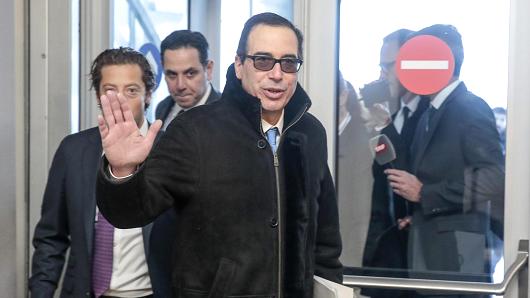
Steven Mnuchin, U.S. Treasury secretary, center, arrives for a press briefing on day two of the World Economic Forum (WEF) in Davos, Switzerland, on Wednesday, Jan. 24, 2018.
European Central Bank President Mario Draghi also speaks Thursday after an interest rate meeting, and he may too be asked to comment on the surge in the euro. A sharply higher euro could be problematic for Europe’s exporters, while a weaker dollar would help U.S. exports.
However, too much dollar weakness also makes U.S. assets, including Treasury debt, less attractive, and pushes the cost of goods higher for businesses and everyday Americans.
Mnuchin’s comment carried a particular sting since they follow new tariffs issued this week by the Trump administration on washing machines and solar panels. The U.S. this week is also engaged in a sixth round of talks to renegotiate the NAFTA agreement with Canada and Mexico.
President Donald Trump will speak at Davos on Friday, and U.S. officials, including Commerce Secretary Wilbur Ross are promoting ‘America first’ policies on trade at the Davos gathering.
Some strategists believe Mnuchin’s comments may have been taken out of context, since the Treasury secretary also spoke at the same time in favor of a strong dollar—U.S. policy since the 1990s.
“Longer term, the strength of the dollar is a reflection of the strength of the U.S. economy and the fact that it is and will continue to be the primary currency in terms of the reserve currency,” Mnuchin was quoted as saying.
But the market chose to focus on the comment about weakness, possibly because the Davos gathering is viewed as a bastion of globalization and free trade. Later, Ross attempted to change the narrative in an interview on CNBC, when he took issue with the interpretation that the U.S. is in a policy shift, but the dollar continued to weaken.
The White House, however, did not say much to clarify the situation, saying only that it believes in a free trading currency and that the dollar is stable.
Mnuchin’s comments, if they do indicate a shift, depart from the policy of the past three presidential administrations and Treasury secretaries, going back to Robert Rubin. Prior to Trump, presidents in recent history have refrained from talking the currency up or down.
The dollar lost 0.8 percent against the euro, which reached 1.24 in U.S. trading, and 1 percent against the yen.





