

U.S. Democrats found several reasons to celebrate the one-year anniversary of one of the most devastating, demoralizing nights in their party’s history.
A surge in voter turnout helped Democrats coast to victory in two governor’s races one year after the tidal-wave election that swept Donald Trump and a historic number of Republicans to office last Nov. 8.
Their victory in Virginia was particularly sweet as that race bore uncanny similarities to last year’s events, filling Democrats with a sense of deja vu, and dread that the strategy that propelled Trump to office might prove to be a winning long-term formula.
They couldn’t beat Trump last year. But they rejoiced the small blows dealt to Trumpism in Virginia and New Jersey, as the downtrodden Democrats elected two governors as well as the first transgender state lawmaker in U.S. history.
The parallels with the 2016 presidential election had observers casting Virginia in particular as a test of the Trump model — with the idea that a Republican victory in the wealthy swing state might prove that the nationalist, populist, culture-warrior approach could win virtually everywhere in America.
Trump took special interest in the race, with his Twitter feed filled with get-out-the-vote messages. He factored into the messaging of both parties, including early campaign ads where the Democratic contender called the president, “a narcissistic maniac.”
But when the votes were counted, Democrat Ralph Northam beat Republican Ed Gillespie by a wider-than-expected margin — nine points.
Ed Gillespie worked hard but did not embrace me or what I stand for. Don’t forget, Republicans won 4 out of 4 House seats, and with the economy doing record numbers, we will continue to win, even bigger than before!
Trump-Clinton redux?
An area political scientist says it’s probably wrong to treat this race as some kind of 2016 rematch holding great meaning about the imminent fate of American politics, since a whole bunch of other factors are at play, including 100 state legislative races happening simultaneously.
But people will do it anyway.
“The national media have tended to make this a referendum — a kind of Trump-Clinton redux: Here we are a year later,” said Lauren Bell of Randolph-Macon College in Ashland, Va.
“[If Republicans win] the national takeaway is going to be that Trump was not a one-off. That he’s not some cult of personality. That the way Republicans can win is by… appealing to white voters’ fears of a changing society. I’m not entirely certain that’s an accurate explanation… but I suspect the story will be, ‘This is how Republican candidates can win.”‘
Just look at the familiar storyline.

Gubernatorial candidates Republican Ed Gillespie, left, and Democrat Lt. Gov. Ralph Northam debate in McLean, Va., Sept. 19. (Bonnie Jo Mount/The Washington Post/Associated Press)
A wealthy, big-city Republican once again cast himself as conservative culture-warrior. Well-connected Washington lobbyist Gillespie ran racially tinged messages about protecting Confederate statues, expelling Latino criminals and football players not kneeling for the national anthem.
Democrats entered the race with a considerable lead, but the polls tightened. Their message of economic-opportunity-for-all was swamped in sociological polemics. There was also fear of an enthusiasm gap on the left. Northam, a former army doctor who twice voted for George W. Bush, was scorned by some progressives. Morale wasn’t helped by a new book that reawakened bitter memories from Wikileaks — the party’s ex-chair wrote that Senator Bernie Sanders was cheated in last year’s primary.
Mid-cycle races matter for other reasons.
Poor results in 2013 races proved a harbinger of electoral doom ahead for Democrats — in 2014 and 2016, the party lost both chambers of Congress and a century-old record 34 governorships and the presidency.
But there are new slivers of light emerging for Democrats.
They have been gaining votes in recent elections, while Republicans have been losing them amid an unpopular first-year presidency, says a new memo by Kyle Kondik and Geoffrey Skelley of the University of Virginia.
They calculated Democrats have outperformed Clinton’s 2016 margin in 31 of 42 open-seat elections held across the country since last fall, with an average gain of 11 percentage points.
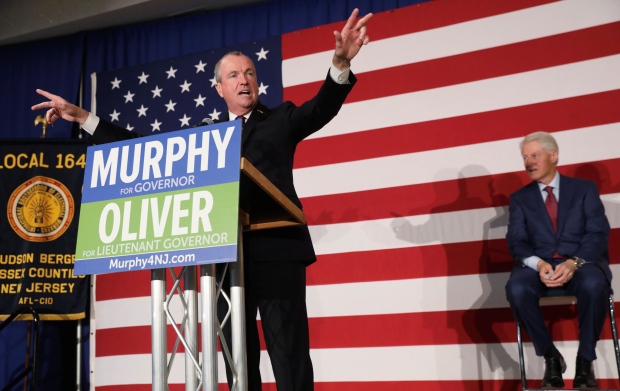
Philip Murphy, the Democratic Party nominee for Governor of New Jersey, speaks in front of former U.S. President Bill Clinton during a campaign event in Paramus, New Jersey, U.S., Oct. 24. (/Lucas Jackson/Reuters)
That kind of surge, if sustained, could flip control of the U.S. House of Representatives next year.
In New Jersey, Democrat Phil Murphy defeated Republican Lt.-Gov. Kim Guadagno, who was at the side of Gov. Chris Christie for the past eight years.
Guadagno, who campaigned on lowering property taxes and ending so-called sanctuary cities, had tried to distance herself from Trump and the scandal-plagued Christie.






