
China on Wednesday proposed that North Korea could suspend its nuclear and missile activities in exchange for a halt in joint military drills conducted by the U.S. and South Korea.
Foreign Minister Wang Yi likened escalating tensions between the North and Washington and Seoul to “two accelerating trains, coming toward each other with neither side willing to give way.”
“The question is: Are the two sides really ready for a head-on collision?” Wang told reporters. “Our priority now is to flash the red light and apply the brakes on both trains.
Wang said China proposes that as a first step to defusing the looming crisis, the North might suspend its nuclear and missile activities if the U.S. and South Korea halted their military exercises.
“This suspension-for-suspension can help us break out of the security dilemma and bring the parties back to the negotiating table,” Wang said, describing the approach as trying to address all parties’ concerns in a “synchronized and reciprocal” manner.
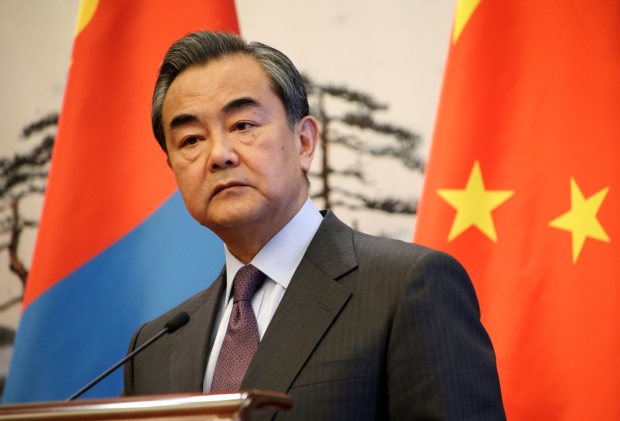
China’s Foreign Minister Wang Yi likened North Korea and those supporting South Korea as ‘two accelerating trains’ on Wednesday. (Jason Lee/Reuters)
China has also rejected accusations from U.S. President Donald Trump that Beijing could be doing more, saying the problem was ultimately between Washington and Pyongyang.
China has been stepping up pressure on North Korea, its once-close Communist ally, to give up its nuclear and ballistic missile programs. Last month, Beijing suspended all coal imports from North Korea for the rest of the year.
China is North Korea’s largest source of trade and aid, and the move deprives the North of an important source of foreign currency. Beijing wants the U.S. in return to restart long-stalled negotiations with North Korea to ease regional tensions.
The missiles North Korea fired on Monday were unlikely to have been intercontinental ballistic missiles (ICBMs), South Korea said, which can reach the United States. They flew on average 1,000 kilometres and reached an altitude of 260 kilometres. Some landed as close as 300 kilometres from Japan’s northwest coast, Japan’s defence minister said earlier in the week.
Wang also urged South Korea to suspend deployment of a U.S. anti-missile system that he called a “wrong choice,” saying it is the biggest problem hurting relations between Beijing and Seoul. On Tuesday, U.S. missile launchers and other equipment needed for the system arrived in South Korea.
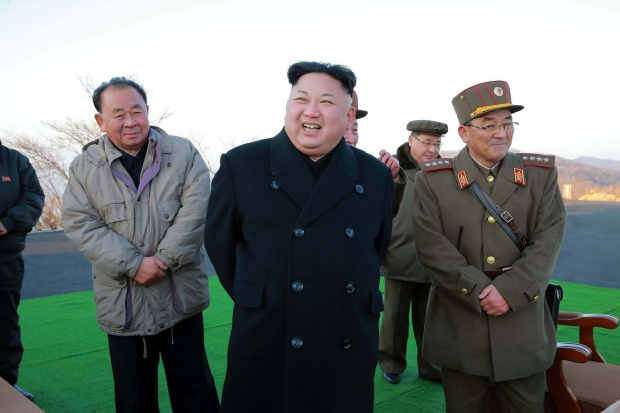
This undated picture released by North Korea’s Korean Central News Agency (KCNA) via KNS on March 7 shows North Korean leader Kim Jong-un supervising the launching of four ballistic missiles by the Korean People’s Army (KPA) during a military drill at an undisclosed location. (KCNA via KNS/AFP/Getty Images)
Washington and Seoul say the system is defensive and not meant to be a threat to Beijing or Moscow. The U.S. military said THAAD can intercept and destroy short and medium-range ballistic missiles during the last part of their flights. China is opposed to the system, saying it would allow U.S. radar to peer deep into its territory and monitor its flights and missile launches.
“We urge some forces in South Korea not to keep insisting on taking this path, otherwise the result can only be damage to others and harm to yourself,” Wang said.
On Tuesday, China’s foreign ministry said Beijing will take “necessary measures” to protect itself against the deployment of the system and warned that the U.S. and South Korea should be prepared to bear the consequences.