

Hurricane Irma, a powerful Category 4 storm, plowed toward the Caribbean and the southern United States on Tuesday as islands in its path braced for possible life-threatening winds, storm surges and flooding.
Hurricane warnings and watches were in effect for territories that dot the West Indies, including parts of the Leeward Islands, the British and U.S. Virgin Islands and Puerto Rico, in preparation for a storm that was intensifying with 220 km/h winds, the U.S. National Hurricane Center said.
The U.S. National Weather Service said in an advisory on Monday: “Preparations should be rushed to completion as tropical storm-force winds are expected to arrive in the hurricane warning area by late Tuesday.”
In preparation for the storm, the government of economically struggling Puerto Rico declared a state of emergency and activated the National Guard on Monday.
The U.S. island territory, home to about 3.4 million people, has 456 emergency shelters prepared to house up to 62,100 people. Puerto Rico also activated a price freeze on basic necessities, including food and water, medicines, power generators and batteries, to help residents prepare.
The executive director of the state power authority, Ricardo Ramos, told the station that the power grid was so vulnerable from lack of investment that parts of the U.S. territory could be without power for three to four months.
“We’re preparing for the worst-case scenario,” he said.
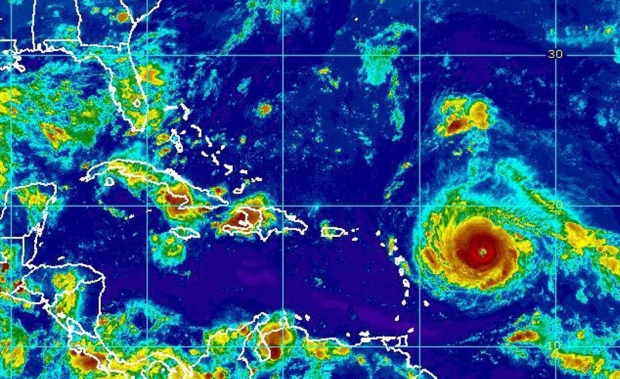
This Monday, Sept. 4, 2017, satellite image shows Hurricane Irma nearing the eastern Caribbean. Hurricane Irma grew into a powerful Category 4 storm Monday. (NOAA/Associated Press)
Too early for certainty
Irma also threatens the U.S. East Coast and Florida, which declared a state of emergency on Monday night. The hurricane centre expects Irma to reach southern Florida on Saturday.
Florida Gov. Rick Scott said on Twitter late on Monday he had spoken to U.S. President Donald Trump, who he said “offered the full resources of the federal government as Floridians prepare for Hurricane Irma.” The NHC cautioned that it was too early to forecast the storm’s exact path or what effects it might have on the continental United States, but warned of likely effects to hit some areas by later this week.
“There is an increasing chance of seeing some impacts from Irma in the Florida Peninsula and the Florida Keys later this week and this weekend. In addition, rough surf and dangerous marine conditions will begin to affect the southeastern U.S. coast by later this week,” the centre said.
Irma will be the second powerful hurricane to thrash the United States and its territories in as many weeks. Residents of Texas and Louisiana are still reeling from the catastrophic effects of the deadly Hurricane Harvey, which struck Texas as a Category 4 hurricane on Aug. 25 and dumped several feet of rain, destroying thousands of homes and businesses.






