

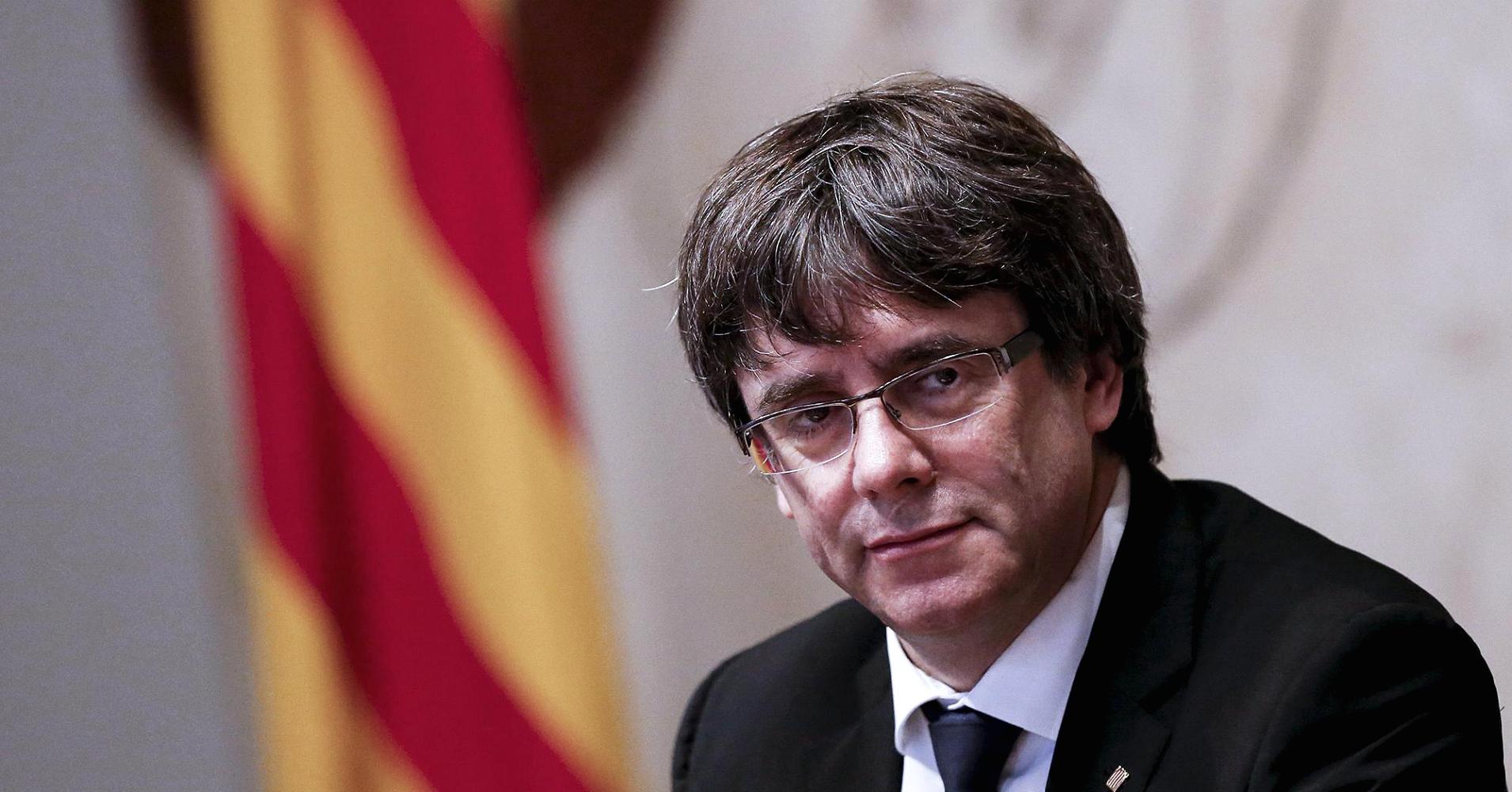
Catalan leader Carles Puigdemont has not given a clear answer to whether the region has declared independence or not, according to a letter sent to the Spanish government.
The letter, sent just two hours before a deadline imposed by Madrid, reiterated an offer to meet Spanish Prime Minister Mariano Rajoy as soon as possible to discuss the situation in Catalonia, and asked that dialogue take place over the next two months, Reuters reported.
This is a breaking news story, please check back later for more.
The political impasse between Spain and Catalonia reached a decisive stage Monday with a deadline for pro-separatists to clarify whether it had declared independence or not. The Catalan government was given until Monday 09:00 a.m. London time to state its position.
The demand from Spanish Prime Minister Mariano Rajoy came after Catalan President Carles Puigdemont made an ambiguous statement last Tuesday in which he seemed to declare independence before suspending it, calling for dialogue with Madrid.
Dialogue is something that the Spanish government has refused to enter into, however, given that it wants Catalonia to show its hand before it decides its response.
If Puigdemont does declare independence Monday, he will be given an additional three days to rectify it, until Thursday October 19 at 9:00 a.m. London time.
If a declaration of independence is pursued at this further deadline, Rajo has said he would be ready to invoke Article 155 of the Spanish Constitution which would allow him to sack the regional government and call for fresh elections.
This scenario is still likely, according to analysts.
“If the Catalan government chooses a hard line, we expect that Article 155 will be triggered (there are three more days for that to happen, with a final deadline set for next Thursday). While it is difficult to predict the exact contours of its implementation, we foresee that in due time a new regional election will be called in an attempt to restore the normal institutional set up,” JPMorgan economist Marco Protopapa said in a note last week looking ahead to the deadline.
The Catalonia government — which had been emboldened to pursue independence following a non-binding referendum in the region in which a majority of voters voted for secession — had subsequently been weakened, in Protopapa’s view, by a fracture within the pro-independence camp between more radical hard-liners and more moderate elements calling for dialogue with Spain.
In addition, a number of high profile businesses have threatened to relocate out of the northeastern region and the European Union has said an independent Catalonia would find itself isolated, outside the bloc.
Protopapa said the Catalan government “had been weakened by these events” while Bob Parker, investment committee member at Quilvest Wealth Management, said in a note this weekend that both Spain and Catalonia had a lot to lose if the situation deteriorated.
“The Catalan Government were concerned by the movement of businesses from Barcelona to Madrid and were disappointed by the lack of EU support. For Spain, an independent Catalonia would weaken its economic and financial position since Catalonia accounts for 16 percent of
Spanish gross domestic product (GDP); consequently , there is pressure on both sides to arrive at an equitable solution,” he said.






