
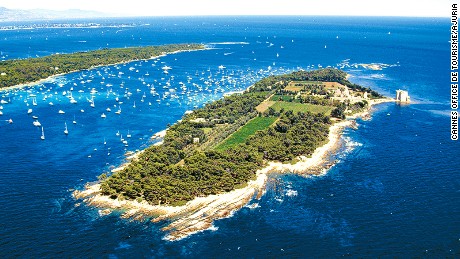
Îles de Lérins: A serene getaway from Cannes.
The Îles de Léhrins consist of two main islands, serviced by several ferry lines and two mini offshoots reached only by private or hired boat. The largest, Île Sainte-Marguerite, harbors hidden coves, tidal pools and beaches and is crisscrossed by a network of well-marked walking trails.
Just over three quarters of a mile long and less than half a mile wide, tiny Île Saint-Honorat is home to the Abbaye de Lérins, where 20 Cistercian brothers live a life of solitude tending acres of vineyards from which they make award-winning wines.
For divers and snorkelers — and yachts, this being Cannes — the waters around and between the islands are a marine paradise, home to scores of protected species under sunny skies. (The islands are said to average 300 days of sun a year).
Neither island allows cars or bikes and there are no hotels on the islands, but visitors are free to explore from early morning until the last ferry leaves at 6 p.m.
Île Saint-Honorat: A very French history
Since Saint Honorat reputedly drove away a menacing dragon around the year 410, monks have populated this tiny archipelago. A fortress built between the 11th and 14th century helped the friars withstand pirates, Saracen attacks and occupation by Spanish raiders, until Louis XIV garrisoned the island in the 1600s.
Spiffed up in the 19th century by French restorer-in-chief Eugène Viollet-le-Duc, the fortress is now a scenic ruin. Its four floors of chapels, vaulted ceilings and arches topped by crenelated ramparts culminate in camera-ready views of Cannes, the Alpine range and the cape of Antibes.
A half-dozen chapels scattered along the island’s ring path offer moments of repose.
If a day isn’t sufficient to regain your serenity, the monastery reserves guest rooms for contemplative retreats lasting between two days and one week.

The Cistercian brothers produce award-winning wines.
This Cistercian brotherhood may shun the limelight, but their highly prized organic wines are the island’s big draw.
The monks make several liqueurs from top-secret recipes, including the aromatic Lérina, made with 44 herbs and seeds, and sunny Lérincello, made from the famously luscious lemons of Menton, just down the coast.
Though you can circumnavigate the island in two to three hours, a placid stroll through the monks’ eight flower-strewn acres of vineyards and olive groves is just the thing for a restorative afternoon.
Across the bay from the Croisette, history and nature converge on Île Sainte-Marguerite. Barely two miles long and a half-mile across, the island’s splendid tree-lined paths, secluded beaches and scenic picnic spots under Aleppo pines and towering eucalyptus make for a perfect day outdoors.
At the island’s southeastern edge, birdwatchers get a close-up glimpse of swans, herons, egrets and sandpipers — plus falcons and sparrow hawks — as they noisily congregate around the Étang du Batéguier, a pond mixing fresh and salt waters.
But the island’s biggest attraction is 17th-century Fort Royal, the perfect faraway isle to confine France’s most famous prisoner, the Man in the Iron Mask. From 1687 to 1698 the mystery captive, rumored to be Louis XIV’s heir, bastard brother or even his true father, was locked away, far from prying eyes.
At the Musée de la Mer, housed in the fort, the island’s long history — from the Ligurians and Romans to medieval times — is set out in the remains of a Roman vault, with captivating displays of local shipwreck plunder.
Fort Royal, Île Sainte-Marguerite, 06400 Cannes, France
You can pack a lunch and head to one of the islands’ many picnic tables or a sandy spot on the beach with endless views of the Esterel coastline, Cannes and the snowy peaks of the Alps beyond. But outdoor gourmet dining is never far away.

The clear azure waters make the islands a water sports paradise.
Ferries to the island depart every hour or half hour from Cannes’ Quai Laubeuf, at the tip of the Vieux Port all year round.
Île Sainte-Marguerite is serviced by several companies operating from the quay. Ferries leave every half hour (14.5 euros or $16, child 9.5 euros or $11).
American journalist Jennifer Ladonne, who’s called Paris home for 12 years, writes regular travel features for France Today magazine and is the Paris restaurants and hotels reviewer for Fodor’s Paris travel guide.