

MARK GRAHAM/AFP/Getty Images
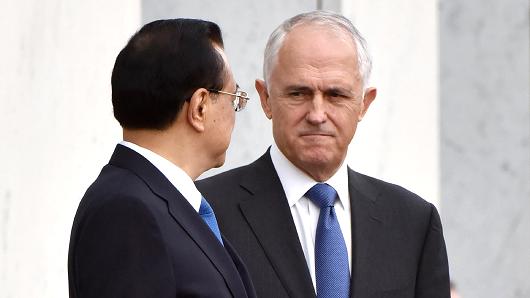
Australia’s Prime Minister Malcolm Turnbull looks at China’s Premier Li Keqiang on March 23, 2017. Australia urged China on March 23 to press ahead with economic reforms as Li began a trade-focused visit amid growing fears of a U.S. slide towards protectionism.
Beijing has invited Canberra to align the Northern Australia Infrastructure Facility — a A$5 billion ($3.82 billion) government program — with B&R. Chinese President Xi Jinping first floated the idea last year and Foreign Minister Wang Yi reiterated it last month.
But no formal agreement will be signed during Li’s visit, Australian government officials told media outlets ahead of Li’s arrival on Wednesday.
Investing in the name of B&R makes it easier for mainland entities to pursue overseas deals. As the world’s second-largest economy cracks down on outbound investments in an attempt to halt capital outflows, Beijing will only encourage transactions in approved sectors, such as B&R.
From an economic point of view, China’s invitation makes sense seeing as northern Australia is in desperate need of capital, but geopolitics plays a key role in Canberra’s reluctance, explained Jane Golley, associate director of the Australian Centre on China in the World research institute at the Australian National University.
The U.S., one of Canberra’s oldest allies, may be sensitive to growing Chinese influence in northern Australia as it maintains a military presence there — since 2012, U.S. Marines have been deployed to Darwin, the capital of Australia’s Northern Territory, for joint exercises, training and exchanges with the Australian Defense Force. Last year, Washington expressed concern that the leasing of Darwin Port by Shandong-based Landbridge Group could result in Chinese intelligence collection on U.S. and Australian troops.
So Washington may not be pleased if Canberra accepted China’s invitation, and following President Trump’s recent scolding of Turnbull, the PM may not wish to further strain ties with the world’s largest economy, Golley told CNBC.
Thanks to Trump’s ‘America First’ agenda, Australia and other U.S. allies in Asia-Pacific have been faced with the prospect of greater Chinese engagement to make up for a reduced American presence in the region. But Australia appears reluctant to turn its back on Washington, with Foreign Minister Julie Bishop recently asking the U.S. to play an even greater role “as the indispensable strategic power in the Indo-Pacific.”





