
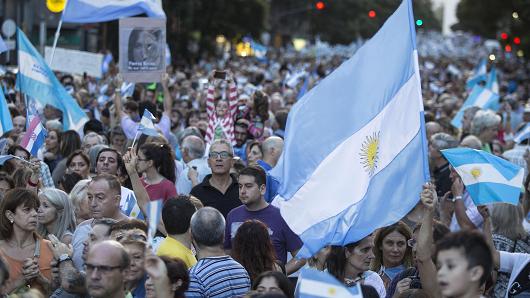
Mariano Sanchez | Anadolu Agency | Getty Images
Thousands gather to attend a march in support of President Mauricio Macri and his government at Plaza de Mayo in Buenos Aires, Argentina on April 1, 2017.
Political conservative Macri was elected in 2015, leading the country’s Cambiemos (Spanish: Let’s change) coalition. One year prior, Argentina had defaulted on its debts to the tune of $1.3 billion, a hangover from its 2001-2002 financial crisis which saw the country surrender to one of the largest sovereign debt defaults in history.
Juan Sartori, founder and executive chairman of conglomerate Union Group and Latin America expert, told CNBC via e-mail that Macri was elected on the hope that he would “restructure” the country’s sputtering economy and “allow it to fit back into the world economic order.”
“His focus has been on expanding the financial services sector and restoring its international credibility. These are still his objectives,” Sartori said.
Green shoots have begun to emerge. The IMF forecasts gross domestic product growth for 2017 to be 2.2 percent, an improvement considering that the figure was a negative 2.3 percent in 2016. Unemployment is also projected to fall 1.1 percentage points to 7.4 percent this year. Earlier in March, ratings agency Moody’s upgraded its outlook for Argentina from stable to positive.
As of 2017 Argentina’s central bank has introduced an inflation target range, aiming for 5 percent as of 2019.