
German Chancellor Angela Merkel is welcoming U.S. President Donald Trump, Prime Minister Justin Trudeau and other leaders of the Group of 20 global economic powers to a two-day summit in Hamburg.
The meeting at the city’s trade fair centre opens Friday with a discussion on fighting terrorism — one of the least contentious subjects on an agenda that also includes global trade and climate.
Merkel says she hopes to find “compromises and answers” on a range of issues at the two-day meeting of leading economic powers opening Friday. While there’s little disagreement on fighting terrorism, prospects of finding common ground on climate change and trade look uncertain.
Prime Minister’s office says Justin Trudeau spoke about climate change, Paris agreement, in morning meeting with Angela Merkel #hw
Trump, Putin meet
But all eyes are on Trump and Russian President Vladimir Putin, who met for the first time in person on Friday.

U.S. President Donald Trump and Russian President Vladimir Putin met in person for the first time as they arrived for the G20 leaders summit in Hamburg. (Carlos Barria/Reuters)
Trump had tweeted earlier this morning that he was looking forward to his meeting with Putin, saying there is “much to discuss.”
I look forward to all meetings today with world leaders, including my meeting with Vladimir Putin. Much to discuss.#G20Summit #USA🇺🇸
Putin’s spokesman Dmitry Peskov told reporters that Putin and Trump “shook hands and told each other that they will shortly have a separate meeting.”
Asked about Trump’s tweet that he’s looking forward to meeting with Putin, Peskov answered that the Russian president is also looking forward to the encounter.
It’s a pivotal time in U.S.-Russian relations. Trump has said he wants to find ways to work with Putin, a goal made more difficult by sharp differences over Russia’s actions in Syria and Ukraine, and allegations Moscow meddled in the 2016 U.S. presidential election.
The meeting is scheduled for 3:45 p.m. local time (9:45 a.m. ET), shortly after a G20 working session on climate and energy begins. Trump, who has angered world leaders with his decision to pull the United States out of the Paris accord on climate change, will likely have to leave that session early to make the Russia meeting.
Protests continue
The meeting opens after skirmishes between police and violent protesters in the port city, Germany’s second-biggest. Officers repeatedly used water cannons, as well as pepper spray and batons on Thursday evening amid clashes with violent protesters.
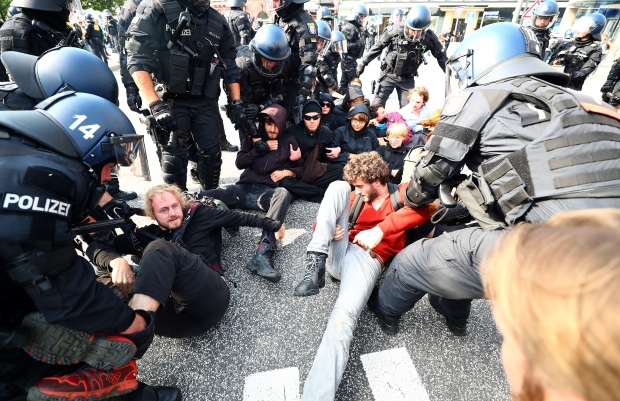
German police remove protesters who blocked a street at a demonstration ahead of the summit. (Pawel Kopczynski/Reuters)
Friday morning, Hamburg police say they used a water cannon to clear a blockade by protesters ahead of the summit’s opening. Police said the incident happened on the banks of the Outer Alster lake, some distance from the trade fair grounds where the summit is being held. They said they had repeatedly told a group of protesters to clear the road.
Police said at least 111 officers were hurt, one of whom had to be taken to a hospital with an eye injury after a firework exploded in front of him. Twenty-nine people were arrested and another 15 temporarily detained. Windows at the Mongolian consulate were also broken.
The city has boosted its police with reinforcements from around the country and has 20,000 officers on hand to patrol Hamburg’s streets, skies and waterways.
On Friday, there were further incidents but nothing on the scale of the previous evening.
The G20 comprises Argentina, Australia, Brazil, China, Germany, France, Britain, India, Indonesia, Italy, Japan, Canada, South Korea, Mexico, Russia, Saudi Arabia, South Africa, Turkey, the United States and the European Union. Saudi Arabia’s King Salman isn’t attending, and his country is represented by Ibrahim al-Assaf, the minister of state.
Also attending the summit are the Netherlands, Norway, Spain, Guinea, Senegal, Singapore and Vietnam.
Leaders of China, India, Russia, Brazil and South Africa have met on the sidelines of the summit in Germany, calling for a more open global economy.