
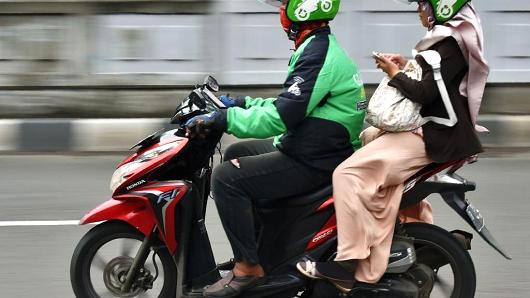
Bay Ismoyo | AFP | Getty Images
A Gojek rider transports a passenger in Jakarta on February 2, 2017.
CNBC recently tested out the service on the Indonesian island of Bali. The 10-minute ride on a motorbike, cost the equivalent of about 30-cents. While cash payment was accepted, using payment platform GoPay would have offered a roughly 25-percent discount.
Southeast Asia has seen Uber and Singapore-based Grab expand aggressively, and both companies also offer a motorbike option in parts of Indonesia.
“It’s a most uniquely positioned company and I don’t see it as a pure Uber or Grab competitor but as a hybrid tech play. Its payments capabilities and wide array of customer offerings are most interesting,” Ozi Amanat, founder of venture capital firm K2 Global told CNBC.
“Southeast Asia is a vibrant economy with a massive population and growing spending power,” he added.
Indonesia is by far the largest nation in the region, with a population of roughly 250 million people. In addition to Go-Jek being homegrown, it’s also at the early stages of potentially creating its very own ecosystem, similar to WeChat in China.
Not only can users order a ride from bikes and cars, Go-Jek is also used as a food delivery service and as an online payments system. For instance, users can order Starbucks on the app and a biker then picks up the job for delivery.
Go-Jek was recently in talks to raise an additional $1 billion, according to The Wall Street Journal.