

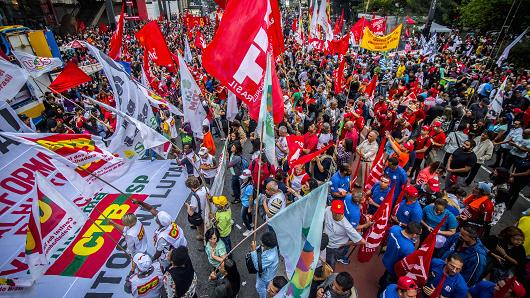
Cris Faga | LatinContent | Getty Images
Members of the Roofless Movement protest againts economic reforms proposed by President Michel Temer at Paulista Avenue in Sao Paulo on June 30, 2017.
Meirelles took the position in 2016 amid the global commodities downturn and during the impeachment of former president Dilma Rousseff, previously serving as central bank governor from 2003 to 2011.
Brazil’s GDP did show signs of recovery in the fourth quarter of 2017 for the first time after falling for eight consecutive quarters, though further confidence in the country remains sensitive to political developments, according to the Organization of Economic Cooperation and Development (OECD).
Meirelles would not confirm whether he will make a presidential bid for October, though he told CNBC he is thinking about it, and will make his decision in “late March or early April.”
“If the decision in October proves to be the right one and the country embarks on a higher growth rate next year which I think is possible, I think the story could be a reasonable one, or even a very good one,” he said.
Brazil’s government has pledged a raft of reforms, but regional watchers warn that continued reform is not guaranteed, particularly given the country’s upcoming presidential election in October 2018 which will pit unpopular incumbent Michel Temer against the scandal-ridden former president Lula da Silva. Investors are already warning of volatility.
Dogged by political corruption scandals and high-profile arrests, the country of 208 million continues to miss out on stronger growth thanks to a combination of red tape, protectionist measures, low export levels, high import tariffs and inadequate infrastructure.
Credit Suisse in 2017 named Brazil the most closed emerging market economy, and Standard & Poor’s recently downgraded Brazil’s credit rating, citing slow political progress.





