
Alex Bowie | Getty Images
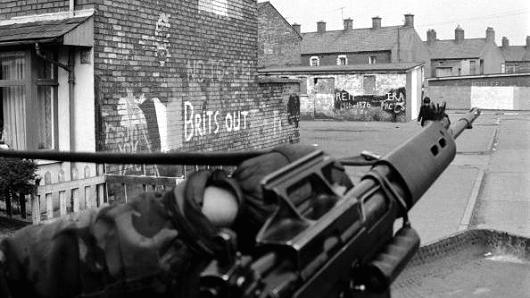
A British Army mobile patrol moves past IRA graffiti in the Republican Ardoyne district of north Belfast, 19th April 1976.
Decades-old wounds
The lengthy guerrilla war over Northern Ireland’s constitutional status, which began officially in 1969, saw more than 3,500 people lose their lives in bombings, indiscriminate shootings and assassinations.
While the opposing sides consisted largely of Catholics (a minority in Northern Ireland), who wanted a united Ireland, versus Protestants, who saw themselves as citizens of Britain, the conflict was not a religious one, but rather an issue of territory and identity.
Although Ireland gained its independence from Britain in 1922 and declared itself a Republic in 1949, Northern Ireland remained a province under the British crown. The spark for what would become known as “The Troubles” came in the summer of 1969, when Catholic groups staged protests against discrimination by the government on their housing, voting and employment rights. Physical retaliation by some Protestant residents and police rapidly escalated into full-blown fighting.
The violence of the subsequent decades was largely carried out by both Irish nationalist and Northern Irish loyalist paramilitaries, such as the Irish Republican Army (IRA), the Ulster Volunteer Force and the Ulster Defense Association, among others. British troops were deployed to the conflict as a stabilizing force, but ended up fueling further fighting in what would be Britain’s longest-ever military deployment, ending only in 2007.