

There have been no street curfews, no violent crackdowns, no appointment of a military junta to take control of the levers of power.
Instead, the man whom the military has supposedly wrestled from power has been shown casually chatting with his captors, while protesters have posed for selfies with soldiers.
Here’s how the coup-that’s-not-a-coup played out.
At first, the situation bore all the hallmarks of a coup: The military had seized control of the state broadcaster ZBC in Harare, soldiers had been deployed at the city’s international airport, and the President was nowhere to be seen.
But that’s not how Maj. Gen. S.B. Moyo wanted it to seem.
“To both our people and the world beyond our borders, we wish to make it abundantly clear that this is not a military takeover of government,” Moyo said.
“As soon as we accomplish our mission we expect (the) situation to return to normalcy.”
Rarely have the major players in a military coup been at such pains to insist that the opposite was true.
A priest, a general, and two South Africans walk into a room…
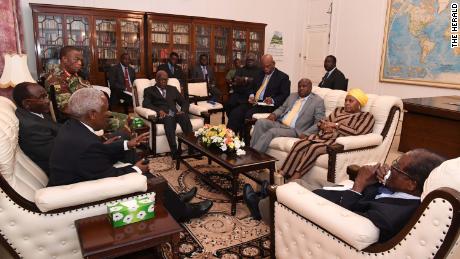
What sounds like the beginning of a bar joke was actually the cast of characters at what, to say the least, was an unusual meeting at State House in Harare, the official residence of President Mugabe.
The event took place a day after the military had seized control in the capital. Yet instead of parading Mugabe in handcuffs, military leaders were shown casually chatting with the man whom they were apparently holding captive.
Business as usual: A nap

In one of the least conventional events of the takeover, Mugabe unexpectedly emerged from house arrest to conduct a public engagement — a university graduation ceremony in the capital.
Two days after the nation had been plunged into a political crisis, his 37-year rule apparently nearing an end, the veteran leader arrived at Zimbabwe Open University in a blue-and-yellow gown, accompanied by his security detail, and conferred degrees upon a parade of students.
The event was clearly orchestrated to convey a impression that business was continuing as usual in Harare, belying the reality that Mugabe was unable to do anything without the approval of military commanders.
Selfies with soldiers

Ordinarily, coup leaders tend to impose curfews and conduct public crackdowns in order to cement their power in the early hours and days of a takeover.
Instead, military leaders in Harare permitted a massive demonstration on Saturday, the third day of the crisis.
Tens of thousands of anti-Mugabe demonstrators took to the streets, singing, dancing and taking selfies with soldiers as military helicopters circled overhead.
Until Wednesday’s army takeover, even minor anti-government protests in Zimbabwe had been met with tear gas, rubber bullets and batons.
The key difference this time was that the aims of the demonstrators and the military — the removal of Mugabe — were aligned.
The goodbye that wasn’t

Four days into the military takeover, the man whom the army sought to depose was still, nominally at least, the President.
On Sunday afternoon, ZANU-PF removed him as its party leader and delivered an ultimatum: Step down by midday Monday or face impeachment.
So, when broadcast trucks from ZBC were summoned to State House hours later, all the expectations were that Mugabe would finally do the generals’ bidding and resign.
Helpfully for the military, Mugabe gave his seal of approval to their actions, declaring the takeover legitimate.
Yet when the address came to an end, 30 minutes later, Mugabe still had not stepped down. “Goodbye,” he said at the end. But was it? Like almost everything else in this very peculiar coup, nothing was quite what it seemed.






