

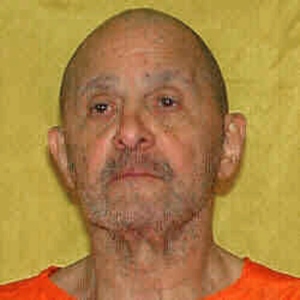
Ohio death row inmate Alva Campbell, 69, was scheduled to die by lethal injection Wednesday for killing a teen during a 1997 carjacking, but state execution team members couldn’t find a vein to insert the IV carrying the lethal drugs. (Ohio Department of Rehabilitation and Correction via AP)
Ohio called off the execution of a condemned killer with multiple health problems on Wednesday because members of the state’s execution team were unable to find a vein to insert an IV that would administer the lethal drugs.
Alva Campbell was scheduled to die for killing a teenager during a carjacking two decades ago.
Campbell’s case marks only the third time in U.S. history that an execution has been called off after the process had begun.
The execution team first worked on both of Campbell’s arms for about 30 minutes Wednesday while he was on a gurney in the state’s death chamber, and then tried to find a vein on his right leg below the knee.
About 80 minutes after the execution was scheduled to begin, Campbell, 69, shook hands with two guards after it appeared the insertion was successful. About two minutes later, media witnesses were told to leave without being told what was happening.
Gary Mohr, head of the Ohio Department of Rehabilitation and Correction, said the team did its best, but the condition of Campbell’s veins had changed since checks on Tuesday.
It wasn’t clear when or if the state would make another attempt to execute Campbell.
Mohr had said earlier in the morning that the execution team was focusing on the accessibility of Campbell’s veins along with issues related to his age.
“We’re not going to rush to execute,” said Mohr.
Alva Campbell’s execution has been delayed for over an hour while prison workers struggle to find a vein. @JohnKasich and the courts should have listened when Alva’s lawyers told them that he was too sick for an execution.
Ohio this year resumed carrying out death penalty sentences after a three-year delay following an execution during which Dennis McGuire repeatedly gasped and snorted during a 26-minute procedure with a never-before-tried drug combination.
In 2009, Ohio inmate Romell Broom survived after a scenario similar to that of Cambpell’s. Then Gov. Ted Strickland called off the execution, which has yet to be carried out as Broom has mounted legal challenges.
Ohio has also fought off legal challenges to keep using midazolam, which was present in the systems of McGuire and men who were executed in problematic circumstances in Arkansas, Arizona and Oklahoma.
Campbell has suffered from breathing problems related to a decades-long smoking habit. His lawyers said he has required a walker, relied on a colostomy bag and needed breathing treatments four times a day.
Prison officials brought him into the death chamber in a wheelchair and provided him a wedge pillow on the gurney.
Campbell’s attorneys had warned the inmate’s death could become a spectacle because of his breathing problems and because an exam failed to find veins suitable for IV insertion.
They argued he was too ill to execute, and also should be spared because of the effects of a brutal childhood.
Asked for firing squad death
Campbell spent Wednesday morning praying and watching TV, said JoEllen Smith, a spokesperson for Ohio’s Department of Rehabilitation and Correction.
The U.S. Supreme Court on Tuesday refused to stop the execution. Last week, Republican Gov. John Kasich denied Campbell’s request for clemency.
Campbell arrived at the death house Tuesday at the Southern Ohio Correctional Facility in Lucasville, about 137 kilometres south of Columbus. In the afternoon, he was calm, Smith said.
The brother, sister and uncle of Charles Dials, fatally shot by Campbell in 1997, were to witness the execution, the Department of Rehabilitation and Correction said. Four lawywers were to witness on behalf of Campbell.
He has chronic obstructive pulmonary disorder as the result of a two-pack-a-day smoking habit, a prisons doctor has said.
Earlier this month, Campbell lost a bid to be executed by firing squad after a federal judge questioned whether lawmakers would enact the bill needed to allow the method.
Franklin County prosecutor Ron O’Brien called Campbell “the poster child for the death penalty.”
Prosecutors said his health claims are ironic given he faked paralysis to escape court custody the day of the fatal carjacking.
On April 2, 1997, Campbell was in a wheelchair when he overpowered a Franklin County sheriff’s deputy on the way to a court hearing on several armed robbery charges, records show.
Campbell took the deputy’s gun, carjacked the 18-year-old Dials and drove around with him for several hours before shooting him twice in the head as Dials crouched in the footwell of his own truck, according to court records.
Campbell was regularly beaten, sexually abused and tortured as a child, his lawyers have argued in court filings and before the Ohio Parole Board.






