

Because just like the iMac G3 and the iPhone, the High Line when it opened in 2009 was not technically anything new. New York’s success was in expertly refining an existing concept. And giving it a catchy name.
Paris, in fact, created the first elevated walkway on a disused rail line — aka high line — back in 1993. The Promenade Plantée tracks the former Vincennes railway, which was constructed in 1859 and last saw a working train in 1969.
Verdant and visually stunning, it was groundbreaking. But tucked away in the city’s 12th arrondissement, most tourists have never heard of it.
Now its New York successor has sparked a global craze for elevated rails-to-trails projects that seems unstoppable.
The high line hype
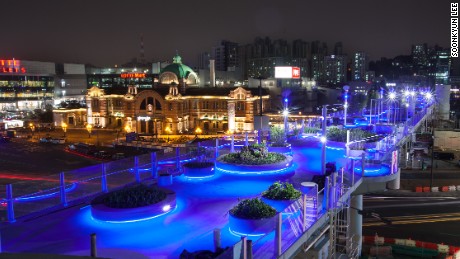
The Seoullo 7017, which opened last month in the Korean capital, is the world’s newest high line.
The walkway connects Seoul Station to Namdaemun Market, and beyond, and features almost 25,000 trees, shrubs and flowers in cylindrical planters which light up blue at night.
Each city has its own take on the concept.
For the Log Road Daikanyama, the focus is as much on shops and cafes as oaks and shrubs, showcasing Japan’s flourishing craft beer scene — one of the reasons Vogue magazine dubbed the area “the Brooklyn of Tokyo”.
Meanwhile, the Luchtsingel was the “world’s first crowdfunded public infrastructure project”, with individuals paying to customize planks along the trail for €25 ($28). A €4 million ($4.5 million) municipal grant also helped this blazing yellow path connect three areas that had been impassable by foot or bike.

‘I wanna be a part of it’
So what exactly made New York’s High Line so franchisable?
Firstly, it had a perfect location. Perched on Manhattan’s Far West Side, it offered an elevated view of Midtown skyscrapers, the Hudson River, West Chelsea and the Meat Packing district. All in an area that had traditionally been industrial, relatively affordable (for Manhattan) and overlooked by tourists.
Professor Ray Bromley, director of globalization studies at the University at Albany, New York, tells CNN he believes it was the “extreme contrast” between the horizontal path of the walkway and the striking verticals of the skyscrapers that made the High Line so successful.
That juxtaposition, of course, had worked once before in New York.
“When Central Park was developed in Manhattan in the late 19th century, people started to really appreciate this extraordinary contrast between the buildings and the green space,” he explains.
Bromley notes that after Central Park “the buildings with the highest real estate value became those that overlooked the green space. And they still are.”
High Line, high prices
The Manhattan High Line’s effect on nearby real estate no doubt also caught city planners’ attention.

Chelsea warehouses have been converted into upscale lofts, and new developments by “starchitects” abound, including the last apartment building by the late British designer Zaha Hadid, condos by Norman Foster (551W21 boasts a 61ft sky pool) and 505 West 19th Street, a block by Danish designer Thomas Juul-Hansen, which has slanted windows to protect against nosy passers-by.
James Howard Kunstler, an American social critic and author of “The Geography of Nowhere”, tells CNN he believes the high line has become the most potent form of downtown regeneration “because the despotic presence of cars and trucks degraded the quality of the most ubiquitous form of urban public space, the street”.
Indeed, the gentrifying effect has not been limited to New York.
Low points of the high line?
Adapting New York’s model, however, is not a guarantee for success, according to urban theorist Christoph Lindner.
And even when it comes to those that do succeed, not everyone is happy.
“The Manhattan High Line unlocked an explosion of gentrification,” says Lindner, “or even hyper-gentrification — where the rich have been replaced by the super-rich.”
“What’s very interesting is the level of pushback from the local community,” adds Lindner, referring to protests about the loss of privacy in the area if tourists stream in and potential gentrification.
The local Woodhaven Residents’ Block Association has said: “We believe that leaving the abandoned rail line alone is the best way to satisfy the needs and desires of as many residents as possible.”
From high to low
Lindner predicts that “we’re going to see a saturation of this concept quite soon”.
But for now that doesn’t seem to be the case. New projects in the pipeline include the Camden High Line in north London, Singapore’s Green Corridor and Philadelphia’s Reading Viaduct.
Sharon Zukin, a professor of sociology at Brooklyn College and author of “Naked City”, says the concept has become so popular because it satisfies two important criteria for modern cities: the desire to rejuvenate “the industrial detritus of the 19th century” and the need to cater to the growing “experience economy”.
The rails-to-trails concept offers “a rare way of experiencing being in the city”.

Located in a one-acre former tram terminal abandoned since 1948, when the service was discontinued, it would rely on “solar collection dishes” above ground to channel light beneath.
“The novelty value is going to wear off,” asserts Lindner. But, he insists, “the general trend of adaptive reuse will continue”.
“The pressure on cities, particularly when it comes to creating green space, is so intense that we have to continue to adapt what we’ve got. We can’t just keep expanding.”






